


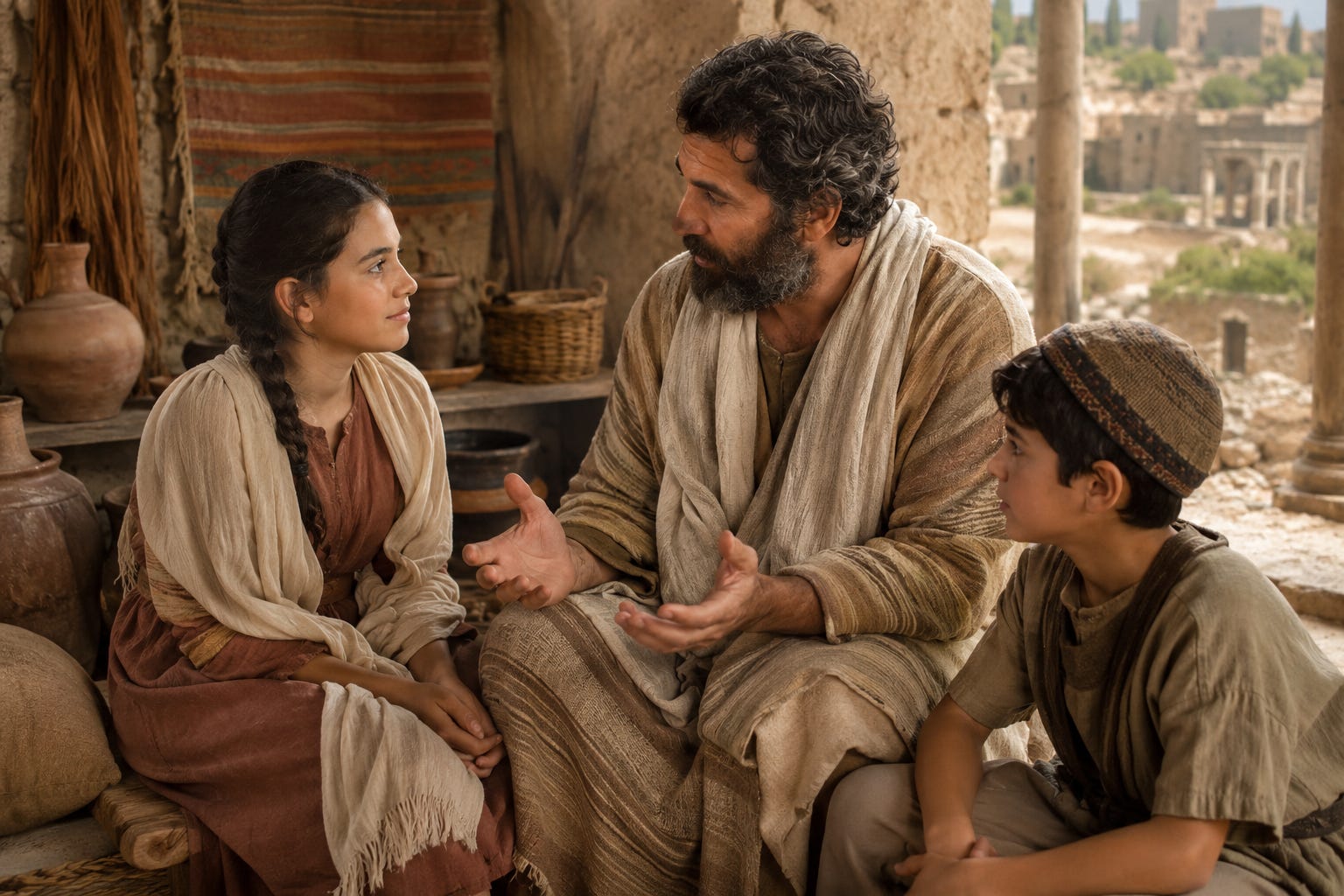
“Fathers, do not provoke your children to anger, but bring them up in the discipline and instruction of the Lord.”
Ephesians 6:4 NASB1995
Paul has advice for parents, too, in this verse in Ephesians 6 (it’s actually directed at fathers). At the time this was written, this was revolutionary, because the patriarch of the family in the Greek, Roman and even Jewish cultures was the final authority and ruled with total domination over the family. According to some of the commentary I read, they could even disown or condemn family members to death. Mothers also had responsibility for bringing up children and teaching them, obviously, but Paul is once again referring to the God-commanded hierarchy in the family, showing that the fathers are ultimately responsible.
Here are some of the ways that fathers can provoke their children, as noted in Precept Austin and adapted from John MacArthur commentary:
Children can be provoked to anger when the father makes unreasonable demands, when he is constantly fault finding, when he neglects his children (as did King David - see 2 Samuel 14-15), or when he is inconsistent.
Here are some additional ways children can be provoked to anger...
(1) Overprotection--never allowing them any liberty, strict rules about everything. They do not trust their kids and the child despairs & [this] can lead to rebellion. Parents must communicate that they trust.
(2) By showing favoritism, often unwittingly.
(3) By depreciating their worth. Many children are convinced that what they do and feel is not important. One way to decrease worth is by not LISTENING. These children may give up trying to communicate and become discouraged, shy, and withdrawn.
(4) By setting unrealistic goals--by never rewarding them. Nothing is enough so they never get full approval. Are you trying to make them into a person they are NOT? Some kids become so frustrated that they commit suicide.
(5) By failing to show affection (verbally and physically).
(6) By not providing for their needs.
(7) By lack of standards (the opposite of overprotection). These children are left to their own. They cannot handle that freedom and begin to feel insecure & unloved.
(8) By criticism. “A child learns what he lives. If he lives with criticism he does not learn responsibility. He learns to condemn himself and to find fault with others. He learns to doubt his own judgment, to disparage his own ability, and to distrust the intentions of others. And above all, he learns to live with continual expectation of impending doom.” Parents should seek to create in the home a positive, constructive environment.
(9) By neglect. David was indifferent to Absalom.
(10) By excessive discipline. Never discipline in anger. (Adapted from John MacArthur - see MacArthur, J. Colossians. Chicago: Moody Press)
No parent is perfect. I talked to Steve about this while I was writing the devotional. His father did not show affection and was difficult to know or understand or please; my father was slow to anger and kind, without being too indulgent (usually). I had great difficulty in pleasing my mom in anything that I did; Steve’s mom was fun-loving and easy going, but could also be really stubborn. I’m not sure how we would have been as parents, but knowing our mindset in those years we wandered in the wilderness when child-bearing was possible, it would not have been God-centered.

Children should be brought up in the discipline and instruction of the Lord. Let’s do a word study on discipline from the Blue Letter Bible:
Discipline comes from the Greek feminine noun παιδεία or paideía (Strong’s G3809), with the following Biblical usages:
the whole training and education of children (which relates to the cultivation of mind and morals, and employs for this purpose now commands and admonitions, now reproof and punishment) It also includes the training and care of the body
whatever in adults also cultivates the soul, esp. by correcting mistakes and curbing passions.
instruction which aims at increasing virtue
chastisement, chastening, (of the evils with which God visits men for their amendment)
Ray Stedman has a great commentary on this verse, as noted in Precept Austin:
Lack of discipline will make a child insecure, miserable, and self-centered. That is what we call “a spoiled child”--one who grows up to expect to have her way in everything and who rides roughshod over the feelings of everyone else. This is created by a spirit of indulgence on the part of parents who allow their children to make decisions that no child is capable of making. Parents must learn that they need to make decisions for their children for quite a while in their life and only gradually help them to learn to make those decisions as they are able to do so. In the early years of childhood parents must make almost all the decisions. One of the terribly tragic things about life today is the degree to which many parents let children make decisions they are incapable of making.
The other extreme that provokes a child to revolt is harshness--rigorous, demanding discipline that is never accompanied with love or understanding. Rigid, military discipline that says, “Do this, or this, or else,” will inevitably drive a child to revolt as he comes to adolescence.
Opposed to this the apostle puts two things--training and instruction (or exhortation) in the Lord. The word for instruction is really “putting in mind” in the Lord. Training and putting in mind in the Lord. As the child grows older, physical discipline is to be replaced by exhortation, by understanding--helping a child to see what lies behind the restrictions and always showing concern and love. It does not mean a total relaxing of limits, but it means a different way of enforcing them.
Father, thank You that You can change the mistakes I have made as a parent into opportunities for advancement in my children’s lives as well as my own life. (Ephesians 6:1-4 Parents And Children)
Excellent advice from Roy Stedman! The Lord should be first in our minds every single day.
My next devotional examines Ephesians 6:5-6 - Slaves, be obedient to your masters.
Heaven on Wheels Daily Prayer:
Dear Lord - I am grateful for my parents and in-laws, regardless of their faults. I regret not having the experience of raising a child myself, but I hope to reach others with Your precepts through these devotionals. Amen.
Citations and Credits:
Scripture quotations taken from the (NASB®) New American Standard Bible®, Copyright © 1960, 1971, 1977, 1995 by The Lockman Foundation. Used by permission. All rights reserved. www.Lockman.org.
“G3809 - paideia - Strong’s Greek Lexicon (NASB95).” Blue Letter Bible. Web. 17 Jun, 2026. <https://www.blueletterbible.org/lexicon/g3809/nasb95/mgnt/0-1/>.
Precept Austin was accessed on 06/17/2026 to review commentary for Ephesians 6:4.
Commentary from Enduring Word is used with written permission and without any alteration. ©1996-present The Enduring Word Bible Commentary by David Guzik – enduringword.com. Enduring Word commentary was not used for this devotional.