


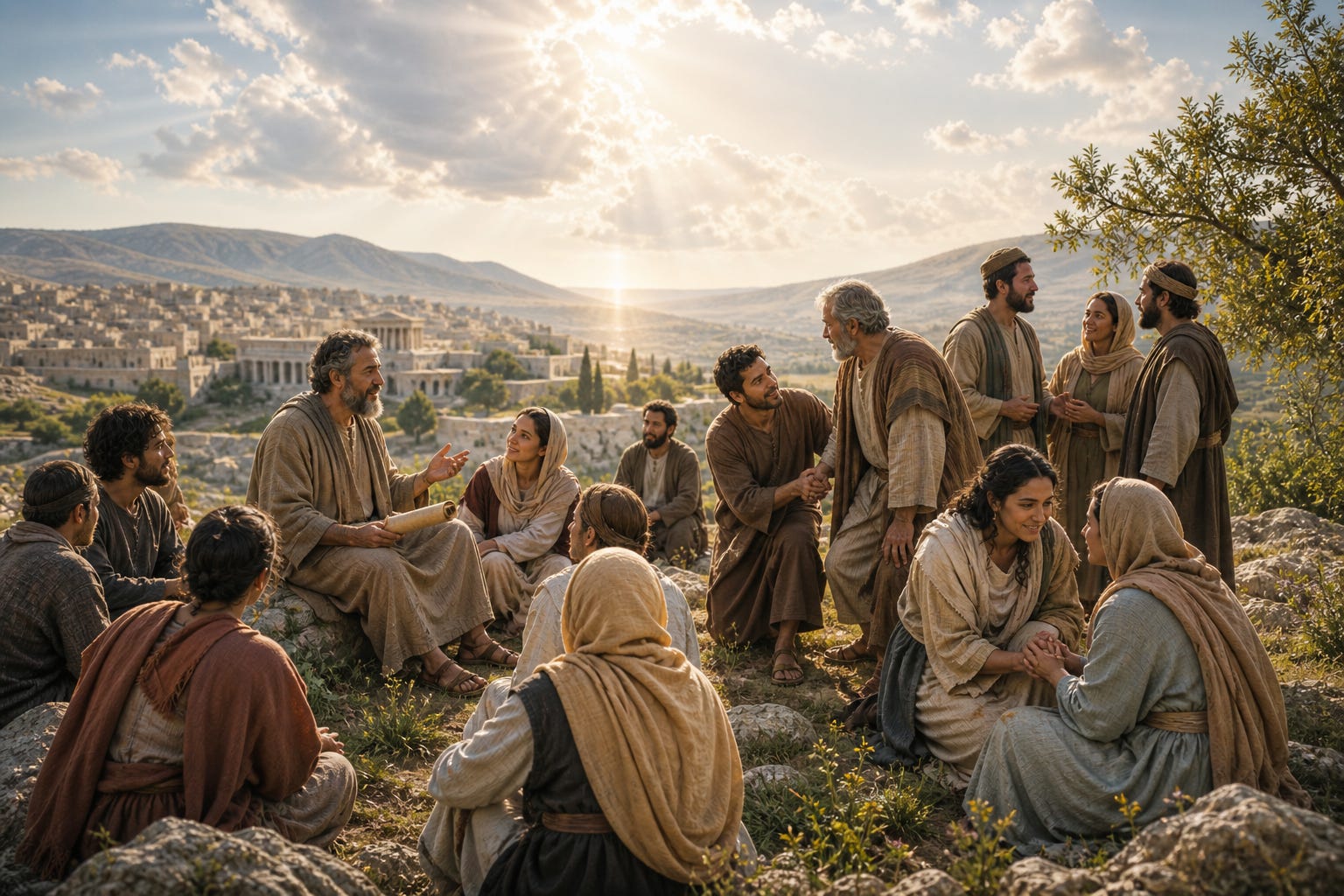
“(Now this expression, “He ascended,” what does it mean except that He also had descended into the lower parts of the earth? He who descended is Himself also He who ascended far above all the heavens, so that He might fill all things.) And He gave some as apostles, and some as prophets, and some as evangelists, and some as pastors and teachers, for the equipping of the saints for the work of service, to the building up of the body of Christ; until we all attain to the unity of the faith, and of the knowledge of the Son of God, to a mature man, to the measure of the stature which belongs to the fullness of Christ.”
Ephesians 4:9-13 NASB1995
Well, there’s nothing like having to dive into a little controversy among Biblical scholars when examining what Paul has written, especially the parenthetical statement in verses 9 and 10 of this passage of Ephesians 4. Precept Austin has a handy list of possible meanings from the NET Bible notes:
Ephesians 4:9 is a much debated passage and the NET Bible note summarizes the most likely interpretations (the first two being the most commonly mentioned by conservative writers) of the lower parts of the earth...
(1) The traditional view understands it as a reference to the underworld (hell), where Jesus is thought to have descended in the three days between his death and resurrection. In this case, “of the earth” would be a partitive genitive.
(2) A second option is to translate the phrase “of the earth” as a genitive of apposition: “to the lower parts, namely, the earth” (as in the present translation). Many recent scholars hold this view and argue that it is a reference to the incarnation. (ED: See John Piper’s analysis - Did Jesus Descend into Hell?)
(3) A third option, which also sees the phrase “of the earth” as a genitive of apposition, is that the descent in the passage occurs after the ascent rather than before it, and refers to the descent of the Spirit at Pentecost (cf. Acts 4:11-16). Support for this latter view is found in the intertestamental and rabbinic use of Ps 68:18 (quoted in Eph 4:8), which is consistently and solely interpreted as a reference to Moses’ ascent of Mt. Sinai to “capture” the words of the law. The probability, therefore, is that the comments here in v. 9 reflect a polemic against the interpretation of Ps 68:18 in certain circles as a reference to Moses. (NET Bible)
Well that clears things up (NOT)! Here’s what Enduring Word says about this:
d. Now this, “He ascended”; what does it mean: In this, Paul demonstrated how the words He ascended in Psalm 68:18 had reference to the resurrection of Jesus, speaking first of His rising from the lower parts of the earth, and secondly of His ascension far above all the heavens.
i. Some think that the phrase lower parts of the earth refers to Jesus’ preaching to the spirits in prison described in 1 Peter 3:19 and 4:6. While this aspect of Jesus’ ministry in Hades following His work on the cross is true (and prophesied in Isaiah 61:1-2 and Luke 4:18), Paul did not necessarily refer to it here.
Let’s look at the passage in 1 Peter 3:
“For Christ also died for sins once for all, the just for the unjust, so that He might bring us to God, having been put to death in the flesh, but made alive in the spirit; in which also He went and made proclamation to the spirits now in prison, who once were disobedient, when the patience of God kept waiting in the days of Noah, during the construction of the ark, in which a few, that is, eight persons, were brought safely through the water.”
1 Peter 3:18-20 NASB1995
So this passage in 1 Peter implies that Jesus visited those who were in the prison of an afterlife of some kind awaiting the Lord (they were put to death in the flesh, but made alive in the spirit). I welcome readers to read what I wrote about this passage in 1 Peter at this link. Enduring Word also accepts the veracity of the prophecies that Jesus was in Hades during this interval (note: this is NOT the same as hell).
Repeating what I alluded to in the 1 Peter devotional, I grew up in the Lutheran Church and on most Sundays we would stand there in the pews or rows of seats droning our way through the Apostle’s Creed (I say “droning” because I often found myself just mumbling the words without thinking about them, one of the serious limitations with liturgical-based worship). Bibles.net has the following text for this Creed:
I believe in God, the Father almighty,
creator of heaven and earth.
I believe in Jesus Christ, his only Son, our Lord,
who was conceived by the Holy Spirit
and born of the virgin Mary.
He suffered under Pontius Pilate,
was crucified, died, and was buried;
he descended to hell.
The third day he rose again from the dead.
He ascended to heaven
and is seated at the right hand of God the Father almighty.
From there he will come to judge the living and the dead.
I believe in the Holy Spirit,
the holy catholic* church,
the communion of saints,
the forgiveness of sins,
the resurrection of the body,
and the life everlasting. Amen.
*that is, the true Christian church of all times and all places
Translation © 1988, Faith Alive Christian Resources. Used by permission. All rights reserved worldwide.
Lutherans and many other denominations take this Creed at face value, in confirmation classes and during worship services. But how do you reconcile this journey into “hell” between the crucifixion and resurrection with the proclamation from Jesus to the believing thief on the cross that on that very day the thief would be with Him in paradise? Let’s muddy the waters even more by looking at this answer from Gotquestions.org:
In the Hebrew Scriptures, the word used to describe the realm of the dead is sheol. It simply means “the place of the dead” or “the place of departed souls/spirits.” The New Testament Greek equivalent of sheol is hades, which also refers to “the place of the dead.” The New Testament indicates that sheol/hades is a temporary place, where souls are kept as they await the final resurrection and judgment. Revelation 20:11–15 makes a clear distinction between hades and the lake of fire. The lake of fire is the permanent and final place of judgment for the lost. Hades, then, is a temporary place. Many people refer to both hades and the lake of fire as “hell,” and this causes confusion. Jesus did not go to a place of torment after His death, but He did go to hades.
Sheol/hades is a realm with two divisions—a place of blessing and a place of judgment (Matthew 11:23; 16:18; Luke 10:15; 16:23; Acts 2:27–31). The abodes of the saved and the lost are both generally called “hades” in the Bible. The abode of the saved is also called “Abraham’s bosom” (KJV) or “Abraham’s side” (NIV) in Luke 16:22 and “paradise” in Luke 23:43. The abodes of the saved and the lost are separated by a “great chasm” (Luke 16:26). When Jesus died, He went to the blessed side of sheol, or paradise. (Some believe, based on a particular interpretation of Ephesians 4:8–10, that Jesus took believers with Him from sheol to another place of bliss that we now call heaven. More likely, Ephesians 4 refers to the ascension of Christ.) All the unbelieving dead go to the cursed side of hades to await the final judgment. All the believing dead go to the blessed side of hades to await the resurrection. Did Jesus go to sheol/hades? Yes, according to Jesus’ own words, He went to the blessed region of sheol.
Some of the confusion has arisen from such passages as Psalm 16:10–11 as translated in the King James Version: “For thou wilt not leave my soul in hell; neither wilt thou suffer thine Holy One to see corruption. . . . Thou wilt show me the path of life.” “Hell” is not a correct translation in this verse. A correct reading would be “the grave” or “sheol.” Jesus said to the thief beside Him, “Today you will be with me in paradise” (Luke 23:43); He did not say, “I will see you in hell.” Jesus’ body was in the tomb; His soul/spirit went to be with the blessed in sheol/hades. Unfortunately, in many versions of the Bible, translators are not consistent, or correct, in how they translate the Hebrew and Greek words for “sheol,” “hades,” and “hell.”
Ok, well, I think I might be out of my league now, being a rank amateur Bible student. Some things are better left to the mysteries of the life to come. We just need to believe and trust in Him who saved us!

Moving on to the next part of this passage, I’m repeating it here so you don’t have to scroll up:
And He gave some as apostles, and some as prophets, and some as evangelists, and some as pastors and teachers, for the equipping of the saints for the work of service, to the building up of the body of Christ; until we all attain to the unity of the faith, and of the knowledge of the Son of God, to a mature man, to the measure of the stature which belongs to the fullness of Christ.
Some scholars call these roles that the Lord bestowed on humans as the “five-fold ministry”. Enduring Word believes these are four roles, not five as noted in their commentary:
a. He Himself: This means that Jesus established these offices. They are the work and appointment of Jesus, not men. Though pretenders may lay claim to them, the offices themselves are a Divine institution and not a human invention.
b. Gave some to be apostles, some prophets, some evangelists, and some pastors and teachers: Paul described four offices (not five, as in the commonly yet erroneously termed “five-fold ministry”).
i. Apostles, who are special ambassadors of God’s work, though not in the same authoritative sense of the first century apostles. Those first century apostles were used to provide a foundation (preserved as the New Testament) as described in Ephesians 2:20.
ii. Prophets, who speak forth words from God in complete consistency with the foundation of the Old and New Testaments. Sometimes they speak in a predictive sense, but not necessarily so, and they are always subject to the discernment and judgment of the church leadership (1 Corinthians 14:29). As with the apostles, modern prophets do not speak in the same authority as the first century prophets who brought God’s foundational word (Ephesians 2:20).
iii. Evangelists, who are specifically gifted to preach the good news of salvation in Jesus Christ.
iv. Pastors and teachers (or, pastor-teachers; the ancient Greek clearly describes one office with two descriptive titles), who shepherds the flock of God primarily (though not exclusively) through teaching the Word of God. “Teaching is an essential part of the pastoral ministry; it is appropriate, therefore, that the two terms, pastors and teachers, should be joined together to denote one order of ministry.” (Bruce)
v. These gifts are given at the discretion of Jesus, working through the Holy Spirit (1 Corinthians 12:11). The importance of having “all four in operation” in any church body is up to Jesus who appoints the offices. The job of responsible church leadership is to not hinder or prevent such ministry, but never to “promote it into existence.”
That’s an effective commentary! I think it is important to note the admonition that church leadership should not hinder or prevent these roles, but they should also never promote it into existence just to fill a square. The roles in a church are at the discretion of Jesus.
I won’t touch the third rail of whether women should fill any of these roles, but even in the most traditional denominations, women have often performed the role of Sunday School teachers to the young in their congregation. Women also participate in worship teams and in congregational service and I don’t recall any admonitions against women sharing the Good News to individuals and taking part in the Great Commission. God does not ignore my prayers just because I’m a woman and I am free to study Scripture and build a firm foundation for my faith. The Lord has gifted me with gifts that I should use for His glory. There is no male or female in the Lord, as Paul noted in Galatians 3:28. I should caution, however, that in some cases where women have taken over these roles and whole denominations, there has been a profound neglect of the truth of scripture and the embrace of apostasy.
Equipping the saints gives everyone a part in the works of service and in building up the body of Christ, until all obtain a unity and maturity in their faith. Enduring Word commentary again:
c. For the equipping of the saints for the work of ministry: The purpose of these gifts of leadership is also clear. It is that saints (God’s people) might be equipped for the work of ministry (service), so that the body of Christ would be built up (expanded and strengthened).
i. Equipping also has the idea of “to put right.” This ancient Greek word was used to describe setting broken bones or mending nets. These ministries work together to produce strong, mended, fit Christians.
ii. God’s people do the real work of ministry. Leaders in the church have the first responsibility to equip people to serve and to direct their service as God leads.
iii. “The primary purpose of the Church isn’t to convert sinners to Christianity, but to perfect (complete and mature) the saints for the ministry and edification of the Body.” (Smith)
…
a. Till we all come to the unity of the faith: This is the first goal of God’s work through the gifted offices and equipped saints. This is consistent with both the ultimate purpose of God (Ephesians 1:10) and the mystery of God revealed through Paul (Ephesians 3:6).
i. Again, by clearly stating that this is a unity of the faith, Paul did not command a structural or organizational unity, but a spiritual unity around a common faith.
b. And of the knowledge of the Son of God: When the gifted offices work right and the saints are properly equipped, Christian maturity increases and there is greater intimacy in the experience of God.
c. To a perfect man, to the measure of the stature of the fullness of Christ: The gifted offices and equipped saints bring the saints to maturity, according to the measure of Jesus Himself. As years pass by, we should not only grow old in Jesus, but more mature in Him as well, as both individuals and as a corporate body.
Is your church helping to equip the saints to grow in maturity in Christ? I found it interesting in this commentary that one of Guzik’s references describes the primary purpose of the church to be to perfect the saints, not to convert sinners. An excellent resource that I also recommend that was referenced in Precept Austin was from Ray Stedman on how the body of Christ works and it can be found at this link.
My next devotional examines Ephesians 4:14-16 - We are no longer children.
Heaven on Wheels Daily Prayer:
Dear Lord - Thank You for the insights You have provided today as I continue my journey through the Epistle of Ephesians. Amen.
Citations and Credits:
Scripture quotations taken from the (NASB®) New American Standard Bible®, Copyright © 1960, 1971, 1977, 1995 by The Lockman Foundation. Used by permission. All rights reserved. www.Lockman.org.
Precept Austin was accessed on 05/04/2026 to review commentary for Ephesians 4:9-13.
Gotquestions.org was accessed on 05/04/2026 to answer the question, Did Jesus go to hell between His death and resurrection?© COPYRIGHT 2002-2026 GOT QUESTIONS MINISTRIES. ALL RIGHTS RESERVED
Commentary from Enduring Word is used with written permission and without any alteration. ©1996-present The Enduring Word Bible Commentary by David Guzik – enduringword.com. Within the Enduring Word commentary are the following references:
Bruce, Frederick Fyvie The Epistles to the Colossians, to Philemon, and to the Ephesians (Grand Rapids, Michigan: Eerdmans, 1984)
Smith, Chuck New Testament Study Guide (Costa Mesa, California: The Word for Today, 1982)