


“And you were dead in your trespasses and sins, in which you formerly walked according to the course of this world, according to the prince of the power of the air, of the spirit that is now working in the sons of disobedience.”
Ephesians 2:1-2 NASB1995
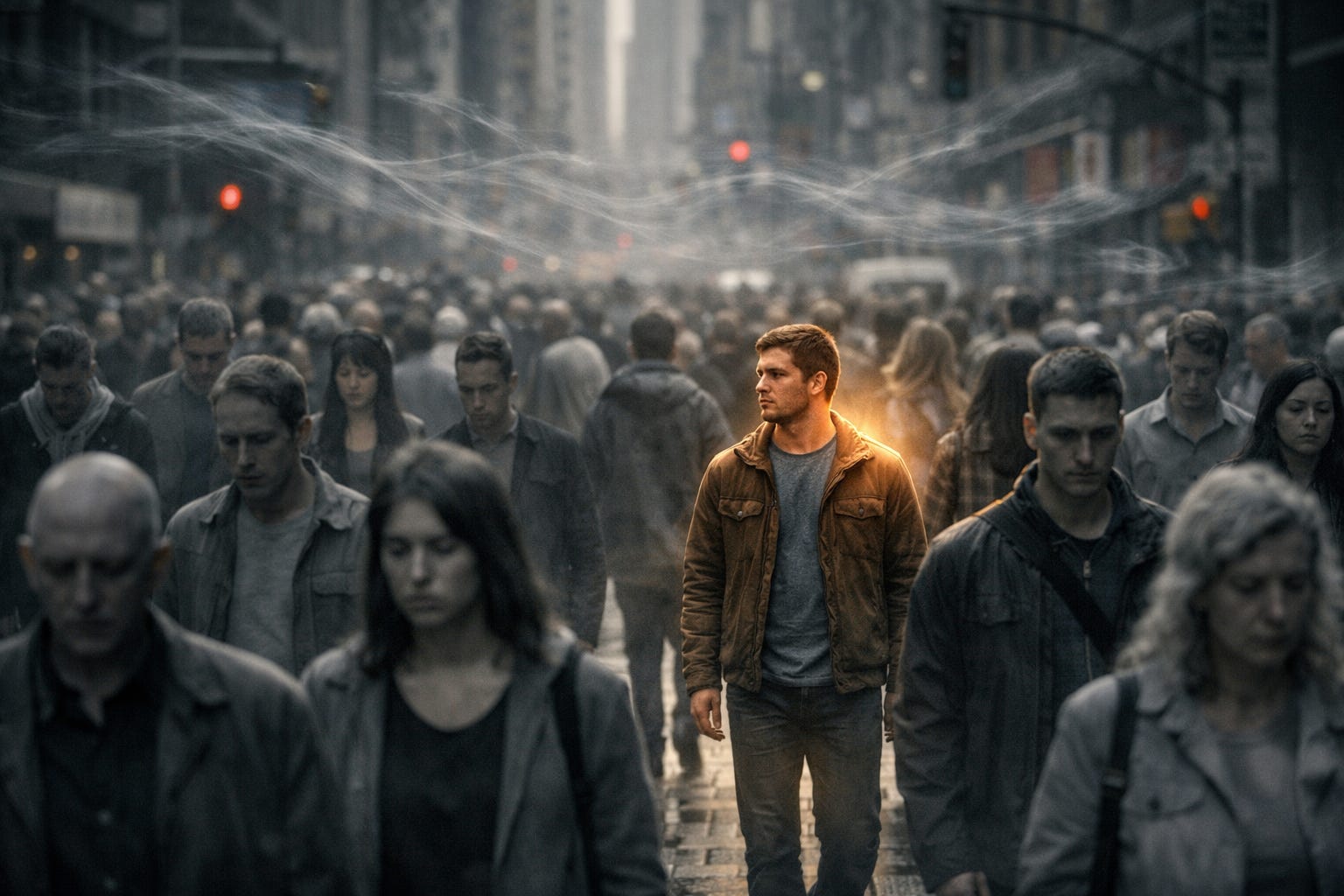
Paul looks at the believers at Ephesus and tells them of the terrible state they were in before they believed in Christ. The AI image that Steve asked for shows a man who is a believer surrounded by what could only be described as the “walking dead”. If we could supernaturally sense those who are spiritually dead they might look like these downtrodden folks.
There are a few words in these two verses to unpack, so let’s do some word studies from the Blue Letter Bible:
Dead comes from the Greek adjective νεκρός or nekrós (Strong’s G3498), with the following Biblical usages:
properly
one that has breathed his last, lifeless
deceased, departed, one whose soul is in heaven or hell
destitute of life, without life, inanimate
metaph.
spiritually dead
destitute of a life that recognises and is devoted to God, because given up to trespasses and sins
inactive as respects doing right
destitute of force or power, inactive, inoperative
In this case Paul is talking about those who are spiritually dead, yet physically alive. When we are spiritually dead, we don’t recognize God and are certainly not devoted to Him. We are not doing what is right so we are “inoperative”.
Trespasses comes from the Greek noun παράπτωμα or paráptōma (Strong’s G3900) with the following Biblical usages:
to fall beside or near something
a lapse or deviation from truth and uprightness
a sin, misdeed
Trespasses miss the mark; they are a lapse or deviation from truth and uprightness. Note that in this passage Paul also calls out sin, which is similarly defined.
Course comes from the Greek noun αἰών or aiṓn (Strong’s G165), with the following Biblical usages:
for ever, an unbroken age, perpetuity of time, eternity
the worlds, universe
period of time, age
This is the age of the world or the perpetuity of time.
The “prince of the power of the air” is referring to Satan. What is the power that is associated with this fallen prince?
Power comes from the Greek noun ἐξουσία or exousía (Strong’s G1849), with the following Biblical usages:
power of choice, liberty of doing as one pleases
leave or permission
physical and mental power
the ability or strength with which one is endued, which he either possesses or exercises
the power of authority (influence) and of right (privilege)
the power of rule or government (the power of him whose will and commands must be submitted to by others and obeyed)
universally
authority over mankind
specifically
the power of judicial decisions
of authority to manage domestic affairs
metonymically
a thing subject to authority or rule
jurisdiction
one who possesses authority
a ruler, a human magistrate
the leading and more powerful among created beings superior to man, spiritual potentates
a sign of the husband’s authority over his wife
the veil with which propriety required a women to cover herself
the sign of regal authority, a crown
The enemy possesses authority over the “air” or the atmosphere of this planet or as it is further defined, these cosmos (the universe). We will see more about this in Ephesians 6:12. In other words, in the only place that humans have fully lived their physical, mortal lives over the centuries is under the enemy’s authority.
Enduring Word has interesting commentary on these first two verses of Ephesians 2; this commentary has been updated to allow the verse to be in a variety of translations, although the commentary is still based on NKJV:
And you were dead in your trespasses and sins, NASB95
a. And you He made alive: The words He made alive are in italics, which indicates that they are added to the text but implied from the context. Paul wrote to believers who were made alive by God’s work.
i. Paul ended the last chapter by considering that the ultimate example of God’s power was the resurrection of Jesus. Now Paul considers what the implications of Jesus’ resurrection power are for our life.
b. Who were dead in trespasses and sins: Though Christians are now alive, they must never forget where they came from. They were dead in trespasses and sins.
i. There are many kinds of life: vegetable life, animal life, mental life, moral life, and spiritual life. A being might be alive in one sense but dead in another. To be spiritually dead does not mean that we are physically dead, socially dead, or psychologically dead. Yet it is a real death, a “dead death” nonetheless. “The most vital part of man’s personality – the spirit – is dead to the most important factor in life – God.” (Wood) “Not in a moral sense, nor a mental sense, but in a spiritual sense, poor humanity is dead, and so the word of God again and again most positively describes it.” (Spurgeon)
ii. This touches on one of the most controversial areas in theology – in what manner, and to what extent, is a person dead before conversion? Must a person be converted before he can believe, or can there be a prior work of God to instill faith that is still short of conversion? Those who argue that man must be regenerated before he can believe like to say that a dead man cannot believe. This takes this particular description further than intended, to say that unredeemed man is exactly like a dead man, because a dead man also cannot sin.
iii. We err if we think that dead in trespasses and sins says everything about man’s lost condition. It is an error because the Bible uses many different pictures to describe the state of the unsaved man, saying he is:
· Blind (2 Corinthians 4:3-4).
· A slave to sin (Romans 6:17).
· A lover of darkness (John 3:19-20).
· Sick (Mark 2:17).
· Lost (Luke 15).
· An alien, a stranger, a foreigner (Ephesians 2:12, 2:19).
· A child of wrath (Ephesians 2:3).
· Under the power of darkness (Colossians 1:13).
iv. Therefore, in some ways the unregenerate man is dead; in other ways he is not. Therefore, it is valid to appeal to all men to believe. We need not look for evidence of regeneration before we tell men to believe and be saved. As the Puritan John Trapp wrote, “Howbeit, the natural man, though he be theologically dead, yet is ethically alive, being to be wrought upon by arguments; hence Hosea 11:4, ‘I drew them by the cords of a man,’ that is, by reason and motives of love, befitting the nature of a man. So the Spirit and Word work upon us still as men by rational motives, setting before us life and good, death and evil.”
c. In trespasses and sins: The idea behind the word trespasses is that we have crossed a line, challenging God’s boundaries. The idea behind the word sins is that we have missed a mark, the perfect standards of God.
i. Trespasses speaks of man as a rebel, sins speaks of man as a failure. “Before God we are both rebels and failures.” (Stott)
…
a. In which you once walked: At one time we lived in trespasses and sins, according to the course of this world, which is orchestrated by Satan. Satan (the prince of the power of the air) is still very much active among those in rebellion against God – the sons of disobedience.
b. You once walked: The self that once walked was the old man, now crucified with Jesus at the time of conversion. The sin nature inherited from Adam influenced the old man, but the world system and Satan do also. One might say that the influence of the old man lives on in what the New Testament calls the flesh.
i. Once walked means it should be different for those who are made alive by Jesus Christ. A dead man feels comfortable in his coffin; but if he were to be made alive again, he would instantly feel suffocated and uncomfortable. There would be a strong urge to escape the coffin and leave it behind. In the same way, when we were spiritually dead we felt comfortable in trespasses and sins; but having come to new life we feel we must escape that coffin and leave it behind.
c. Who now works in the sons of disobedience: In sin we respond to Satan’s “guidance.” The same ancient Greek verb is used in Ephesians 2:2 for the work of Satan in unbelievers as is used in Ephesians 3:20 for the power of God that works in believers.
d. The prince of the power of the air: This unique title for Satan speaks of his authority (prince) and his realm (the air, a way of referring to Satan’s “environment”).
i. “The domain of the air, in fact, is another way of indicating the heavenly realm, which, according to Ephesians 6:12, is the abode of those principalities and powers, world-rulers of this darkness and spiritual forces of wickedness against which the people of Christ wage war.” (Bruce)
ii. Satan is not the ultimate ruler, but he is a prince in the sense that “Evil men set him up for their sovereign, and are wholly at his beck and obedience.” (Trapp)
A few takeaways:
There is a tough theological question posed by this passage according to Guzik: How spiritually dead are we before we are converted? Those who say that we must be regenerated before we can believe are saying that a dead man can’t believe. A dead man can’t sin, either. I like this one comment in Precept Austin: You cannot live a life for God until you receive life from God. --Anonymous
There are other ways to describe the unsaved person, as noted in the list in this commentary:
Blind
A slave (to sin)
A lover of darkness; under its power
Sick
Lost
A stranger or foreigner
A child of wrath
We do not need to look for ANY evidence of regeneration in a person before we tell someone how to be saved!! This needs to be emphasized over and over again.
In our “walking dead” lives we felt comfortable in our sin and trespasses. We responded to Satan’s guidance. But in our redeemed lives, we no longer feel comfortable.

Steven Cole has a good comment about these unseen spiritual powers in our cosmos, as quoted in Precept Austin:
“Sophisticated” modern man scoffs at the notion that such unseen spiritual powers exist. Yet everyone accepts the existence of unseen radio waves, microwaves, and X-rays that travel through the air. We cannot see them, but we can see their effects. It is the same with demonic power. We cannot usually see demons, but we can see the results of their evil power. Paul is not saying that all unbelievers are demon-possessed. But he is saying that Satan and his evil forces actively work in this world through unbelievers. In most cases they are oblivious to it. They go about their lives without much thought about it, except perhaps at Halloween. But worldly people are actually in Satan’s domain of darkness (Col. 1:13). By living independently of God, with no fear of God in their hearts, they are inadvertently furthering Satan’s evil plans to usurp God’s sovereignty.
My next devotional examines Ephesians 2: 3-7 - Made alive together in Christ.
Heaven on Wheels Daily Prayer:
Dear Lord - Help me to be bolder in the proclamation of the Good News to those who are mired in spiritual death. Amen.
Citations and Credits:
Scripture quotations taken from the (NASB®) New American Standard Bible®, Copyright © 1960, 1971, 1977, 1995 by The Lockman Foundation. Used by permission. All rights reserved. www.Lockman.org.
Precept Austin was accessed on 04/02/2026 to review commentary for Ephesians 2:1-2.
Commentary from Enduring Word is used with written permission and without any alteration. ©1996-present The Enduring Word Bible Commentary by David Guzik – enduringword.com.
Spurgeon, Charles Haddon The New Park Street Pulpit, Volumes 1-6 and The Metropolitan Tabernacle Pulpit, Volumes 7-63 (Pasadena, Texas: Pilgrim Publications, 1990)
Stott, John R.W. God’s New Society, The Message of Ephesians (Downer’s Grove, Illinois: InterVarsity Press, 1979)
Trapp, John A Commentary on the Old and New Testaments, Volume Five (Eureka, California: Tanski Publications, 1997)
Wood, A. Skevington “Ephesians: The Expositor’s Bible Commentary” Volume 11 (Ephesians-Philemon) (Grand Rapids, Michigan: Zondervan, 1978)
“G3498 - nekros - Strong’s Greek Lexicon (NASB95).” Blue Letter Bible. Web. 2 Apr, 2026. <https://www.blueletterbible.org/lexicon/g3498/nasb95/mgnt/0-1/>.
“G3900 - paraptōma - Strong’s Greek Lexicon (NASB95).” Blue Letter Bible. Web. 2 Apr, 2026. <https://www.blueletterbible.org/lexicon/g3900/nasb95/mgnt/0-1/>.
“G165 - aiōn - Strong’s Greek Lexicon (NASB95).” Blue Letter Bible. Web. 2 Apr, 2026. <https://www.blueletterbible.org/lexicon/g165/nasb95/mgnt/0-1/>.
“G1849 - exousia - Strong’s Greek Lexicon (NASB95).” Blue Letter Bible. Web. 2 Apr, 2026. <https://www.blueletterbible.org/lexicon/g1849/nasb95/mgnt/0-1/>.