


“Therefore remember that formerly you, the Gentiles in the flesh, who are called “Uncircumcision” by the so-called “Circumcision,” which is performed in the flesh by human hands— remember that you were at that time separate from Christ, excluded from the commonwealth of Israel, and strangers to the covenants of promise, having no hope and without God in the world. But now in Christ Jesus you who formerly were far off have been brought near by the blood of Christ.”
Ephesians 2:11-13 NASB1995
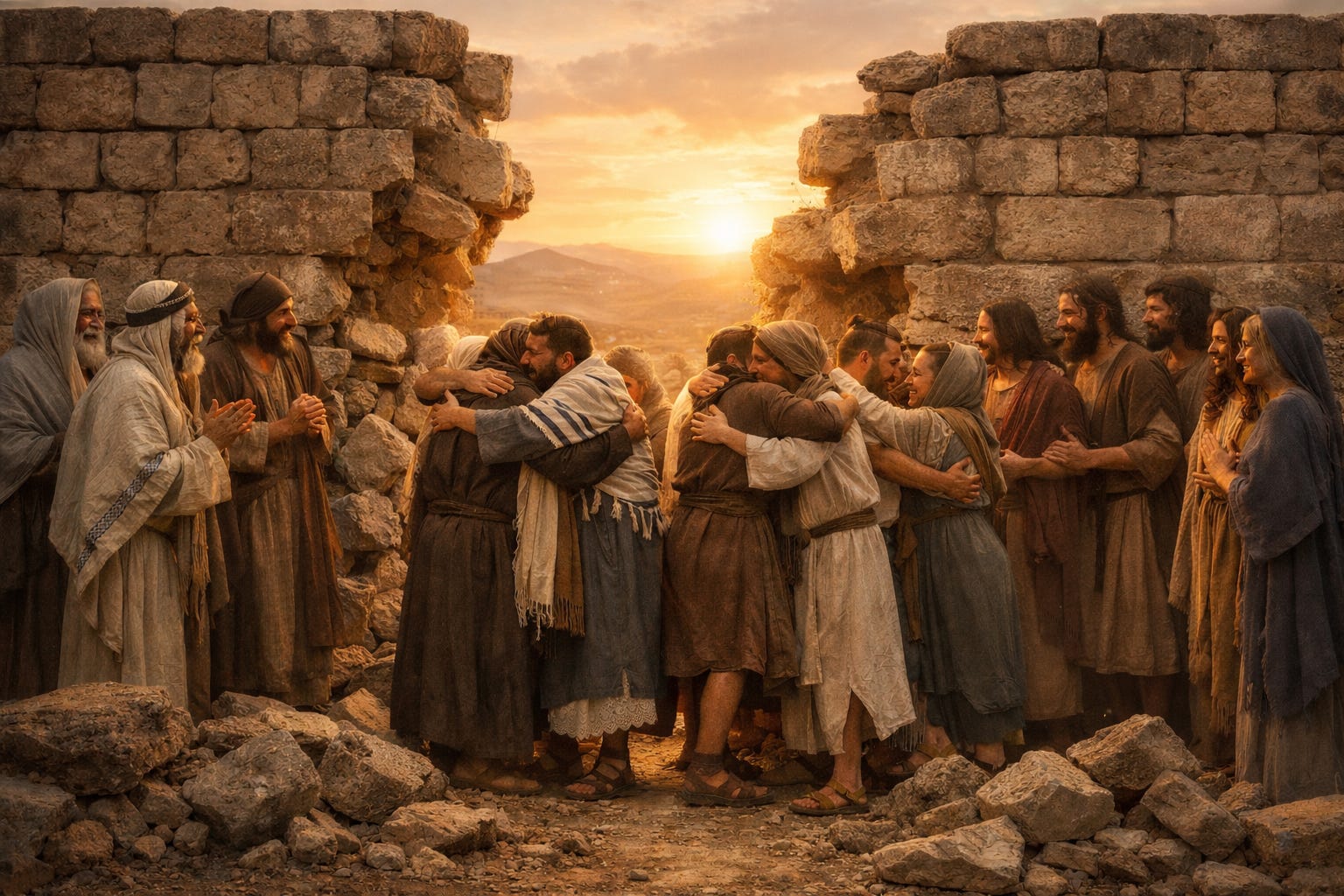
Paul tells the Gentiles at Ephesus to remember that they were separate from Christ, excluded from the commonwealth of Israel and strangers to the covenants of promise. They had no hope and were without God in the world. He also reminds them that they were called unsavory names, like “uncircumcision” (interesting that this usage is a proper noun instead of an adjective like “uncircumcised”). Today’s AI picture shows Christians, both Jewish and Gentile, being reconciled as one in the Lord, with the walls separating them torn down metaphorically.
Remembering where we were in our personal history of faith is important, so that we can see where we are now. I am still a work in progress but many of the sinful behaviors and temperaments that I had earlier in my life have been slowly eroded away and replaced by calm and peace (usually). I have a long journey still ahead of me.
I won’t go into the debate again about circumcision, which was part of the Abrahamic covenant; that topic was covered at length in my devotional series about Galatians, when Paul fought against the Judaizers who wanted Gentile believers to be circumcised. But the point is that the Gentiles and Jews were separated by many things, almost like they lived on different planets. Enduring Word has good commentary on verses 11 & 12:
a. You, once Gentiles in the flesh: God’s work of reconciliation is not only between God and the individual, though it must begin there. It is also between groups of people that are at odds, such as Jews and Gentiles were in the days of Paul.
b. Who are called Uncircumcision by what is called the Circumcision: Gentiles were in a desperate place, being aliens, strangers, having no hope and being without God. This shows that they were not only spiritually dead, but they also did not have the access to God that the Jews enjoyed.
i. Before coming to Jesus, Gentiles were “Christless, stateless, friendless, hopeless and Godless.” (Stott quoting Hendriksen)
ii. Having no hope: “The absence of hope in the face of death is amply attested in the literature and epigraphy of the Greco-Roman world of that day.” (Bruce)
iii. Without God in the world: Some people believe in God, but they believe He lives in heaven and has nothing to do with this world. In that way, a person can still believe in God and be without God in the world.
c. Without Christ: These are terrible words, and the implications of them are the sum of the woeful condition of the lost man or woman. To be without Christ means to be:
· Without spiritual blessings.
· Without light.
· Without peace.
· Without rest.
· Without safety.
· Without hope.
· Without a Prophet, Priest, or King.
i. “Without Christ! If this be the description of some of you, we need not talk to you about the fires of hell; let this be enough to startle you, that you are in such a desperate state as to be without Christ. Oh! What terrible evils lie clustering thick within these two words!” (Spurgeon)
d. Aliens from the commonwealth of Israel: This likely includes separated Jews as well as Gentiles. “For there were also Israelites who were outside the commonwealth, not only as foreigners but as lax Jews, and lost their part in the covenants, not as foreigners, but as unworthy.” (Alford)
There are billions without Christ in our world today, either through ignorance of the Good News or deliberate action to walk in a different direction (disbelief or belief in something else). I was one of those for a number of years, even though I knew the Gospel. I can speak from experience that trying to live a life without Christ becomes a dead life that is without spiritual blessings, without light, without peace, without rest, without safety, and without hope. It is also interesting that people can believe there is a God, but that He has nothing to do with this world.

Verse 13 identifies the reason why those who were far away have been brought near in their faith: It is because of the blood of Jesus Christ. People don’t like thinking about this crucial aspect of our salvation, but His blood was required so that we sinners could be covered in His atoning act on the cross. From Enduring Word again:
a. But now in Christ Jesus: Those Gentiles who are now in Christ Jesus are no longer far off. They are made near to the things of God, and the blood of Christ accomplishes this, by His sacrificial death.
i. This coming near happens only by the blood of Christ. Gentiles who are not in Christ Jesus are just as far off as they ever were. This reconciliation only happens in Jesus.
ii. It is important that Paul connects the ideas of the great love of Jesus and His sacrificial death. Many people think that preaching Christ crucified is all about a bloody, gory Jesus. But the point of Christ crucified is not gore, but love. Preaching Christ crucified means we preach Jesus full of love – sacrificial, giving, saving love.
b. By the blood of Christ: Many people suggest different ways to come near to God. Some think you can come by keeping the law or by belonging to a group (such as Israel or even the church). But the only way to be brought near to God is by the blood of Christ. What Jesus did on the cross, suffering as if He were a guilty sinner in the place of guilty sinners, brings us near to God.
I like this anecdote that was found on Precept Austin from Richard De Haan, on how this fundamental truth of Christ and His love brings believers together:
An elderly man who visited an art gallery was deeply moved by a painting that portrayed Christ on the cross. It was so realistic in depicting the suffering of the Savior that his heart was filled with gratitude for the great price the Lord Jesus paid for his redemption. With tears trickling down his cheeks, he exclaimed, “Bless Him! I love Him! I love Him!”
Other visitors standing nearby wondered what the man was talking about. One person walked over and looked at the painting. Soon he too felt deep emotion welling up in his heart. Turning to the old man, he gave him a firm handshake and said, “So do I! I love Him too!” The scene was repeated as a third man and then a fourth walked over, gazed at the painting, and exclaimed, “I love Him too!” Although these men were from different churches, they felt a common bond because of their faith in Christ.
As believers, we need an awareness of our spiritual unity with other Christians. We need to focus on the fundamentals on which we agree—such as our love for the Savior who died for us—rather than bicker about lesser issues.
Regardless of sincere disagreements, we as blood-bought believers should recognize that we have a strong family tie in Christ.—Richard De Haan
Blest be the tie that binds
Our hearts in Christian love!
The fellowship of kindred minds
Is like to that above. —FawcettAs we draw near to Christ
we are drawn near to each other.
Paul’s lesson in Ephesians is so beautiful. What hope that we have in Jesus!
My next devotional examines Ephesians 2:14-16 - Reconciliation in Christ.
Heaven on Wheels Daily Prayer:
Dear Lord - Help me to always focus on the fundamental truths of Your sacrifice for our salvation. I love you, Lord! Amen.
Citations and Credits:
Scripture quotations taken from the (NASB®) New American Standard Bible®, Copyright © 1960, 1971, 1977, 1995 by The Lockman Foundation. Used by permission. All rights reserved. www.Lockman.org.
Precept Austin was accessed on 04/08/26 to review commentary for Ephesians 2:11-13.
Commentary from Enduring Word is used with written permission and without any alteration. ©1996-present The Enduring Word Bible Commentary by David Guzik – enduringword.com. Within Enduring Word commentary:
Alford, Henry The New Testament for English Readers, Volume II, Part I (London: Rivingtons, 1869)
Bruce, Frederick Fyvie The Epistles to the Colossians, to Philemon, and to the Ephesians (Grand Rapids, Michigan: Eerdmans, 1984)
Spurgeon, Charles Haddon The New Park Street Pulpit, Volumes 1-6 and The Metropolitan Tabernacle Pulpit, Volumes 7-63 (Pasadena, Texas: Pilgrim Publications, 1990)
Stott, John R.W. The Message of Galatians (Leicester, England: Inter-Varsity Press, 1986)