


“So then do not be foolish, but understand what the will of the Lord is. And do not get drunk with wine, for that is dissipation, but be filled with the Spirit, speaking to one another in psalms and hymns and spiritual songs, singing and making melody with your heart to the Lord; always giving thanks for all things in the name of our Lord Jesus Christ to God, even the Father; and be subject to one another in the fear of Christ.”
Ephesians 5:17-21 NASB1995
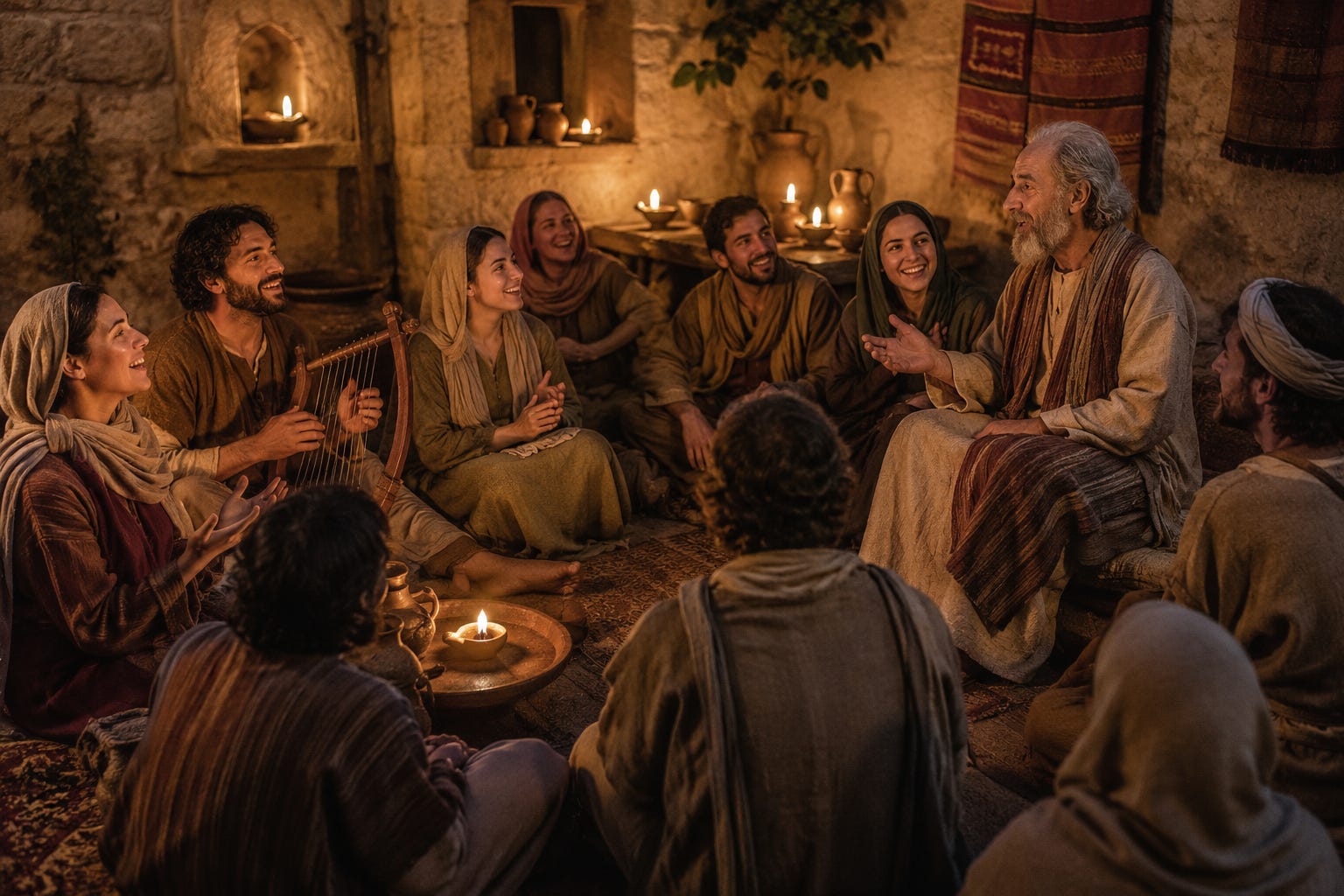
The AI image at the top is a lovely scene. Believers are gathered at a home in Ephesus, speaking to one another and singing songs and learning His Word.
Paul commands the saints at Ephesus to not be foolish, but to understand what the will of the Lord is. Ray Stedman has an interesting take on this understanding, as quoted in Precept Austin:
Be aware of what God wants out of every situation. Now, almost always, when one uses the phrase, "the will of the Lord," most people, including most Christians, understand it in terms of guidance. They think you are referring to what you ought to do next, where you ought to live, what job you ought to have, whom you ought to marry, or how you can decide a problem that is before you. But guidance is not the major problem, or the major factor, in understanding the will of the Lord. God is not half so much interested in what you do as what you are. Therefore, the will of the Lord does not concern itself primarily about what you do. That is a rather simple matter. Once you get the real issue straightened out, what you do is relatively unimportant and can be handled very easily. What you are -- that is the big thing, what you are in every situation. This is what the apostle is talking about. (Sermon).
You can truly say that what you do in this life comes out of what you are. If you are filled with the fruit of the Holy Spirit, then you approach everything in this life (employment, relationships, marriage, family, education, church, mentoring, bad situations, health concerns) with His love, joy, peace, patience, kindness, goodness, faithfulness, gentleness, and self-control. You are His beloved, His ambassador for the faith.
Another good commentary from 19th-century pastor George Mueller (as quoted in Precept Austin) gives us an outline of how to discern God’s will:
1. Surrender your own will.
I seek at the beginning to get my heart into such a state that it has no will of its own in regard to a given matter. Nine-tenths of the trouble with people generally is just here. Nine-tenths of the difficulties are overcome when our hearts are ready to do the Lord’s will, whatever it may be. When one is truly in this state it is usually but a little way to the knowledge of what His will is.
2. Do not depend on feelings.
Having done this, I do not leave the result to feeling or simple impression. If so, I make myself liable to great elusions [illusions].
3. Seek, the Spirit’s will through God’s Word.
I seek the will of the Spirit of God through, or in connection with, the Word of God. The Spirit and the Word must be combined. If I look to the Spirit alone without the Word, I lay myself open to great delusion also. If the Holy Ghost guides us at all, He will do it according to the Scriptures and never contrary to them.
4. Note providential circumstances.
Next I take into account providential circumstances. These often plainly indicate God’s will in connection with His Word and Spirit.
5. Pray.
I ask God in prayer to reveal His will to me aright.
6. Wait.
Considering that we live in the most feelings-oriented therapeutic culture in the history of the world, this is so important to go beyond simple impressions; we must ensure that His Will that you perceive aligns with His Word.

Paul cautions the saints to not be drunk with wine, for that is dissipation (an abandoned life). Paul was not against wine, per se, as he advised Timothy in 1 Timothy 5:23 to forego water and drink a little wine to settle his stomach. But what Paul is concerned with is a lifestyle of drunkenness that replaces being filled with the Holy Spirit. Wine is a marvelous creation and I enjoy a very good red wine with an excellent dinner, but I know that in my younger days that I probably drank more wine (and other alcoholic beverages) than I should have. Here is what Enduring Word says about this passage:
a. And do not be drunk with wine: In contrast with the conduct of the world (being drunk with wine), we are to be filled with the Spirit. Paul’s grammar here clearly says, “be constantly being filled with the Holy Spirit.”
b. Be filled with the Spirit: The filling of the Holy Spirit is not a one-time event that we live off of the rest of our days. It is a constant filling, asking to be filled, and receiving the filling by faith.
i. There is a wonderful and significant first experience with the filling of the Holy Spirit, often thought of as the Baptism of the Holy Spirit (Matthew 3:11, Acts 1:5 and 11:16). This is an experience valid and important for every believer.
ii. Much of the weakness, defeat and lethargy in our spiritual life can be attributed to the fact that we are not constantly being filled with the Holy Spirit.
iii. The ancient Greek grammar for be filled also indicates two other important things. First, the verb is passive, so this is not a manufactured experience. Second, it is imperative, so this is not an optional experience.
c. Do not be drunk with wine: The carnal contrast to being filled with the Holy Spirit is being drunk. The Bible condemns drunkenness without reservation.
i. In which is dissipation: Paul says that drunkenness is dissipation. This means that drunkenness is a waste of resources that should be submitted to Jesus. John Trapp writes of drinking “all the three outs” – “That is, ale out of the pot, money out of the purse, and wit out of the head.” (Trapp’s commentary on Galatians 5:21)
ii. We should listen to what Proverbs tells us about drunkenness in passages such as Proverbs 20:1 and 23:29-33.
iii. We must not think that only the state of “falling down drunk” qualifies as sin. Being impaired in any way by drink is sin, as well as drinking with the intention of becoming impaired.
iv. “The danger of drunkenness lies not only in itself but in what it may induce” (Wood). Practically, the world pays a high price for the ruin of alcoholism and drug addiction. To speak of alcohol alone, according to the United States Center for Disease Control, in 2010 88,000 people died of alcohol related causes in the USA, and excessive drinking cost the USA economy $249 billion dollars – almost a quarter of a trillion dollars. It is fair to suppose that the figures are comparable if not worse in many other nations.
d. But be filled with the Spirit: Paul contrasts the effect of the Holy Spirit with the state of drunkenness. Alcohol is a depressant; it “loosens” people because it depresses their self-control, their wisdom, their balance and judgment. The Holy Spirit has an exactly opposite effect. He is a stimulant; He moves every aspect of our being to better and more perfect performance.
i. “We find it here imbedded amongst precepts laying down the great laws of self-control, and it comes just before the special directions which the Apostle gives for the quiet sanctities of the Christian home… But then, all the while, it is a thing supernatural. It is a state of man wholly unattainable by training, by reasoning, by human wish and will. It is nothing less than – God in command and control of man’s whole life, flowing everywhere into it, that He may flow fully and freely out of it in effects around.” (Moule)

To be filled with the Holy Spirit is to speak to one another in psalms and hymns, sing to one another, make melody in your heart to the Lord, be thankful together, and be subject to one another in fear of Christ.
An example of being filled with the Holy Spirit is from Acts:
“The crowd rose up together against them, and the chief magistrates tore their robes off them and proceeded to order them to be beaten with rods. When they had struck them with many blows, they threw them into prison, commanding the jailer to guard them securely; and he, having received such a command, threw them into the inner prison and fastened their feet in the stocks.
But about midnight Paul and Silas were praying and singing hymns of praise to God, and the prisoners were listening to them; and suddenly there came a great earthquake, so that the foundations of the prison house were shaken; and immediately all the doors were opened and everyone’s chains were unfastened. When the jailer awoke and saw the prison doors opened, he drew his sword and was about to kill himself, supposing that the prisoners had escaped. But Paul cried out with a loud voice, saying, “Do not harm yourself, for we are all here!” And he called for lights and rushed in, and trembling with fear he fell down before Paul and Silas, and after he brought them out, he said, “Sirs, what must I do to be saved?”
They said, “Believe in the Lord Jesus, and you will be saved, you and your household.” And they spoke the word of the Lord to him together with all who were in his house. And he took them that very hour of the night and washed their wounds, and immediately he was baptized, he and all his household. And he brought them into his house and set food before them, and rejoiced greatly, having believed in God with his whole household.”
Acts 16:22-34 NASB1995
I think the commentary from Enduring Word is really good for the second part of this passage:
a. Speaking to one another in psalms and hymns and spiritual songs, singing and making melody in your heart to the Lord: When we are filled with the Spirit, we will have a desire to worship God and to encourage others in their worship of God.
i. The connection with being filled with the Spirit and praise is significant. Those who are filled with the Spirit will naturally praise, and praise is a way that we are filled with the Spirit.
b. Psalms and hymns and spiritual songs: This variety suggests that God delights in creative, spontaneous worship. The most important place for us to have a melody unto God is in our heart. Many who can’t sing a beautiful melody with the voice can have beautiful melodies in their heart.
i. The emphasis is more on variety than on strict categories. “We can scarcely say what is the exact difference between these three expressions.” (Clarke)
c. Giving thanks always for all things to God: The one who is filled with the Spirit will also be filled with thanksgiving. A complaining heart and the Holy Spirit just don’t go together.
i. Paul recommends the same pattern for our thanksgiving as he practiced in prayer in Ephesians 3:14 – giving thanks to God the Father in the name of our Lord Jesus Christ.
ii. “Every hour, yea, every moment has brought a favor upon its wings. Look downward and give thanks, for you are saved from hell; look on the right hand and give thanks, for you are enriched with gracious gifts; look on the left hand and give thanks, for you are shielded from deadly ills; look above you and give thanks, for heaven awaits you.” (Spurgeon)
…
a. Submitting to one another in the fear of God: When we are filled with the Spirit, it will show by our mutual submission to each other; and the submission will be done in the fear of God, not the fear of man.
b. Submitting: The word submitting here literally means, “to be under in rank.” It is a military word. It speaks of the way that an army is organized among levels of rank. You have generals and colonels and majors and captains and sergeants and privates. There are levels of rank, and you are obligated to respect those in higher rank.
i. We know that as a person, a private can be smarter, more talented, and a better person than a general. But he is still under rank to the general. He isn’t submitted to the general so much as a person as he is to the general as a general.
ii. The idea of submission doesn’t have anything to do with someone being smarter or better or more talented. It has to do with a God-appointed order. “Anyone who has served in the armed forces knows that ‘rank’ has to do with order and authority, not with value or ability.” (Wiersbe)
iii. We also see from this how important it is to be “under rank.” In the military, they have a name for it when you no longer want to be “under rank.” They call it “mutiny.” “Just as an army would be in confusion if there were no levels of authority, so society would be in chaos without submission.” (Wiersbe)
c. Submitting to one another: To understand what this means, we can first examine what it does not mean. It does not mean that there is no idea of “rank” in the body of Christ. We can see how someone might take that impression. “It says we should be submitting to one another. So I should be submitting to you and you should be submitting to me. No one has any more obligation to submit than anyone else.”
i. We know this is what Paul does not mean because that would be a clear contradiction of other things that he wrote. For example, in 1 Corinthians 5:1-5, Paul clearly tells the Corinthian Christians to submit to his authority and to do something. Can you imagine the Corinthian Christians answering back, “Well Paul, you wrote that we should be submitting to one another. So we think you should submit to us here.”
ii. Or, another example is Hebrews 13:17, which says Obey those who rule over you and be submissive. If Paul meant that there was no “rank” or “order of authority” among believers, then this command in Hebrews 13:17 is meaningless.
iii. The idea of this military word is more easily applied when one rank is above another. Yet here Paul didn’t use it in that way. It is easily applied when you tell a bunch of privates, “Submit to the generals.” It is a little more difficult to get a hold of the meaning when you say to a group of privates “Submit to one another.” Paul isn’t emphasizing the idea of rank, because he addresses all Christians. But there is something else important here.
iv. Paul means that we should take this “under rank” attitude of the military and apply it to our everyday dealing with each other. When a man joins the military, the first thing he does is strip away his individuality. He is now the member of a company or a battalion. He is no longer an individual. When you join the army, you essentially sign away your right to decide what you want to do with your life and your time. An army is filled with individuals, but they can never be individualistic. That is the first thing that a man is broken of when he joins the army.
v. “Let no man be so tenacious of his own will or his opinion in matters indifferent, as to disturb the peace of the Church; in all such matters give way to each other, and let love rule.” (Clarke)
vi. In practical action submitting to one another implies the following, all in line with the idea of being a “team player”:
· The Christian must not be thoughtless, but think of others.
· The Christian must not be individualistic, must not be self-assertive. “Self-assertion is the very antithesis of what the Apostle is saying.” (Lloyd-Jones)
· The Christian must never be self-seeking.
· We must have a “team attitude.”
· We must be happy when someone else succeeds or does well.
· We must bear our own discomforts and trials with courage.
d. In the fear of God: This is an important point, because Paul repeats the idea all through the extended section speaking about submission:
· Wives, submit to your own husbands, as to the Lord.
· Children, obey your parents in the Lord, for this is right.
· Bondservants, be obedient to those who are your masters according to the flesh, with fear and trembling, in sincerity of heart, as to Christ.
i. The words in the fear of God describe what should be our motive for submitting to one another. We should submit to one other – see ourselves no longer in an individualistic way, but as a unit, as a company or a battalion – out of respect for God the Father respect for Jesus Christ.
ii. The motive for submission is not social kindness. The motive for submission is not the law of God. The motive for submission is respect for Jesus Christ. If we respect Jesus, we then should submit to one another because we love Jesus. Paul uses the term fear in this passage, but it is a fear – a respect – that is compatible with love. It is a fear of disappointing Jesus, a fear of grieving Him. That is totally compatible with love. When you really respect someone, you care about pleasing him or her, and you are afraid to disappoint that one.
There’s a lot to unpack in this commentary. A few key takeaways:
A variety of songs and melodies in the heart can express our love for Christ! I know there are old school types who sneer at any contemporary Christian songs and want organ hymns only and there are worship bands that wouldn’t touch a resounding Martin Luther hymn. The point is, the variety can serve us well, as long as the music is aligned with God’s word.
Go up and read the Spurgeon again on giving thanks. I thought this was absolutely marvelous:
We look down and are thankful that we are saved from hell.
We look right and are thankful that we are given gracious gifts.
We look left and are thankful for being shielded from deadly ills.
We look up and are thankful that we are bound for heaven!
Gratitude is a wonderful way to live life. It is not a popular attitude, however. Envy drives many people these days.
I saw a video the other day on social media of a couple that was homeless and was given (free of charge) a nice little apartment by the city they “dwell in” that had many amenities including heat, A/C, and running water and some modest furnishings. They griped to anyone who would listen about missing their life on the street, they immediately filled the new space with trash and junk, and then they had the nerve to also complain that they wanted something bigger, perhaps with a yard. No gratitude there, only entitlement and envy.
Submitting to one another as believers has a lengthy explanation in the commentary but this is part key:
The Christian must not be thoughtless, but think of others.
The Christian must not be individualistic, must not be self-assertive. “Self-assertion is the very antithesis of what the Apostle is saying.” (Lloyd-Jones)
The Christian must never be self-seeking.
We must have a “team attitude.”
We must be happy when someone else succeeds or does well.
We must bear our own discomforts and trials with courage.
I thought the examples of how submission works in the military were very apt, considering we just finished commemorating the 82nd anniversary of the invasion of Normandy by the Allies. Privates didn’t run the show, the generals did (thank goodness). By breaking down those who served into submission and strong discipline, you created the life-long camaraderie that is exhibited in Band of Brothers (book and series).
R. Kent Hughes is quoted in Precept Austin saying this about gratitude, a subject that should be the heart and soul of the believer:
“..the fullness of the Spirit does call us to a radical spirit of gratitude. We are to thank God in the midst of difficulties for everything which is consistent with his Fatherhood and his loving Son… The fullness of the Spirit rules out a grumbling, complaining, negative, sour spirit. No one can be Spirit-filled and traffic in these things. In America we, as a people, have so much. Yet we characteristically mourn what we do not have: another’s house, car, job, vacation, even family (see word study on envy)! Such thanklessness indicates a life missing the fullness of the Holy Spirit. On the other hand, a positive, thankful attitude announces the presence of the Spirit. I once met a pastor in a remote little western town. His church met in rented facilities, and his car had seen better days, as had his house-trailer. But as we walked down Main Street, stepping around the tumbleweeds, he remarked, “I can’t believe how good God is to me. I have a wonderful wife, a church to serve, and sunshine 365 days a year!” And then he spent the day helping me set up a week-long outreach. What an argument for the reality of Christ and the life-changing power of the gospel in a world which has forgotten to be thankful” (cf. Romans 1:21-note). (Ephesians: The Mystery of the Body of Christ (Preaching the Word -Preaching the Word 1990.)
My hubby and I have done some cruises as part of our travels. We are always amazed and so grateful for the good staff, the great food, the beautiful ships and the interesting destinations and times at sea (or on a river) that showcase God’s creation. But we have run into our share of complainers (and the social media cruise groups are full of them, mostly petty nonsense). Perhaps we should be more vocal in our thanks and it might rub off on others.
Start your day and end your day in thanksgiving (and even song) to God for everything that you have received; it’s the best tonic (and it beats wine) for what ails you!
My next devotional examines Ephesians 5:22-24 - Wives, be subject to your husbands.
Heaven on Wheels Daily Prayer:
Dear Lord - I cannot thank You enough for everything that You have done for me. I am saved by the blood of Christ! Amen.
Citations and Credits:
Scripture quotations taken from the (NASB®) New American Standard Bible®, Copyright © 1960, 1971, 1977, 1995 by The Lockman Foundation. Used by permission. All rights reserved. www.Lockman.org.
Precept Austin was accessed on 06/07/2026 to commentary for Ephesians 5:17-21. Links to the source documents are provided where appropriate.
Commentary from Enduring Word is used with written permission and without any alteration. ©1996-present The Enduring Word Bible Commentary by David Guzik – enduringword.com. Within the Enduring Word commentary:
Clarke, Adam The New Testament with A Commentary and Critical Notes, Volume II (New York: Eaton & Mains, 1831)
Lloyd Jones, D. Martyn: God’s Ultimate Purpose (Grand Rapids, Michigan: Baker Book House, 1980)
Lloyd Jones, D. Martyn: Life in the Spirit, In Marriage, Home & Work (Grand Rapids, Michigan: Baker Book House, 1975)
Lloyd Jones, D. Martyn: The Christian Soldier (Grand Rapids, Michigan: Baker Book House, 1977)
Lloyd Jones, D. Martyn: The Christian Warfare (Grand Rapids, Michigan: Baker Book House, 1981)
Moule, Handley C. G. Ephesian Studies (London: Pickering and Inglis, ?)
Spurgeon, Charles Haddon The New Park Street Pulpit, Volumes 1-6 and The Metropolitan Tabernacle Pulpit, Volumes 7-63 (Pasadena, Texas: Pilgrim Publications, 1990)
Stott, John R.W. God’s New Society, The Message of Ephesians (Downer’s Grove, Illinois: InterVarsity Press, 1979)
Trapp, John A Commentary on the Old and New Testaments, Volume Five (Eureka, California: Tanski Publications, 1997)
Wiersbe, Warren W. The Bible Exposition Commentary, Volume 1 (Wheaton, Illinois: Victor Books, 1989)