



It’s time to plunge into another in-depth study of a book of the Bible. I hope my readers enjoyed the Hebrews journey, although I confess that I found it somewhat difficult at times, but I have some great commentary that I follow and use that helped with the rough patches.
Now I want to take a more relaxing spiritual journey through the Epistle of Ephesians, if one can call an epistle by Paul relaxing. Here is what Enduring Word says about this letter:
a. Paul’s letter to the Ephesians is different compared to many of the other New Testament letters he wrote. Like Romans, Ephesians was not written so much to address problems in a particular church; more so, it was written to explain some of the great themes and doctrines of Christianity.
i. The elevated themes of Ephesians make it highly praised and prized by commentators. Ephesians has been called “the Queen of the Epistles,” “the quintessence of Paulinism,” “the divinest composition of man” and even “the Waterloo of commentators.” Some say that Ephesians reads “like a commentary on the Pauline letters” and probably it has been best termed “the crown of Paulinism.” (Bruce)
ii. “It sums up in large measure the leading themes of the Pauline writings… But it does more than that; it carries the thought of the earlier letters forward to a new stage.” (Bruce)
iii. “Among the Epistles bearing the name of St. Paul there is none greater than this, nor any with a character more entirely its own… There is a peculiar and sustained loftiness in its teaching which has deeply impressed the greatest minds and has earned for it the title of the ‘Epistle of the Ascension.” (Salmond)
iv. “The Epistle to the Ephesians is a complete Body of Divinity. In the first chapter you have the doctrines of the gospel; in the next, you have the experience of the Christians; and before the Epistle is finished, you have the precepts of the Christian faith. Whosoever would see Christianity in one treatise, let him ‘read, mark, learn, and inwardly digest’ the Epistle to the Ephesians.” (Spurgeon)
b. If the Letter to the Romans focuses more on God’s work in the individual Christian, Ephesians includes the great themes of God’s work in the church, the community of believers.
i. Karl Marx wrote about a new man and a new society, but he saw man and society both in almost purely economic terms and offered only economic answers. In his letter to the Ephesians, Paul also saw the new man and a new society, but he saw it all accomplished by the work of Jesus.
c. Ephesians has many similarities with Paul’s letter to the Colossians. Since Paul wrote both of them from his Roman imprisonment, his mind may have worked on the same themes when he wrote each letter.
i. “He wrote to the Colossians to meet a particular situation and danger in the church at Colossae. Then with his mind still working over the theme of the greatness and glory of Christ, but moving on to consider the place of the Church in the purpose of God, he wrote Ephesians, this time without the limitation of any polemical aims.” (Foulkes)
ii. In looking at the great, majestic themes of Ephesians, it is important to remember that Paul wrote this letter from prison.
d. Paul wrote in 1 Corinthians 2:9-10: But as it is written: “Eye has not seen, nor ear heard, nor have entered into the heart of man the things which God has prepared for those who love Him.” But God has revealed them to us through His Spirit. For the Spirit searches all things, yes, the deep things of God. Ephesians is the fulfillment of this. It reveals the things God has prepared for those who love Him.
Well, that sounds absolutely delightful!! As we journey through Ephesians, there will be many “life verses” that we encounter that are probably marked in your Bibles. But I have become more and more convinced that God’s Word is best understood by examining a selected book in detail from verse 1 in the first chapter to the last verse in the last chapter (in this case, that will be Ephesians 6:24). I have learned so much doing these treks through the Bible! And there will be a coda or point in time during this series to introduce the relevant text from Revelation on the warnings to seven churches, including the church at Ephesus.
Here’s an overview of Ephesus from a secular source (Wikipedia); the links and footnotes are retained:
Ephesus (/ˈɛfɪsəs/;[1][2] Ancient Greek: Ἔφεσος, romanized: Éphesos; Turkish: Efes; may ultimately derive from Hittite: 𒀀𒉺𒀀𒊭, romanized: Apāša) was an ancient Greek[3][4] city on the coast of Ionia, in present-day Selçuk in İzmir Province, Turkey.[5] It was built in the 10th century BC on the site of Apasa, a city-state that was also the capital of Arzawa,[6][7] by Attic and IonianGreek colonists. During the Classical Greek era, it was one of twelve cities that were members of the Ionian League. The city came under the control of the Roman Republic in 129 BC.
The city was famous in its day for the nearby Temple of Artemis (completed around 550 BC), which has been designated one of the Seven Wonders of the Ancient World.[8] Its many monumental buildings included the Library of Celsus and a theatre capable of holding 24,000 spectators.[9]
Ephesus was a recipient city of one of the Pauline epistles and one of the seven churches of Asia addressed in the Book of Revelation.[10] The Gospel of John may have been written there,[11] and it was the site of several 5th-century Christian Councils (Council of Ephesus). The city was destroyed by the Goths in 263. Although it was afterwards rebuilt, its importance as a port and commercial centre declined as the harbour was slowly silted up by the Küçükmenderes River. In 614, it was partially destroyed by an earthquake.
Today, the ruins of Ephesus are a favourite international and local tourist attraction, being accessible from Adnan Menderes Airport and from the resort town Kuşadası. In 2015, the ruins were designated a UNESCO World Heritage Site.
The photo gallery below shows the ruins of Ephesus; we visited Ephesus in September, 2011 as a port stop on a cruise from Venice to Istanbul and we did a private tour. I was having severe knee problems so I had to use a travel wheelchair, which was loads of fun for Steve pushing me on uneven surfaces and slogging out way through the ruins; it was a HOT day. I had my first knee replacement one month after we got back from this trip.


Paul apparently preached in the amphitheater that is in the photo at the bottom right of the gallery (it is apparently used currently). The two-story structure in the photo at the bottom left is the Library of Celsus. Excavations of Ephesus began in 1869 through efforts by the British Museum and many groups are still excavating the site. Nearby, the ruins of the Temple of Artemis can be found (once one of the seven wonders of the ancient world, as noted in the Wikipedia excerpt) and also a church dedicated to St. John the Apostle is in the area. For Catholics that visit the area of Ephesus, there is a site not that far away that has the modest home that Mary supposedly lived in towards the end of her life; it is now a shrine. This map, taken from Precept Austin (source unknown), shows the layout of Ephesus around the time of Paul; note the theater location.
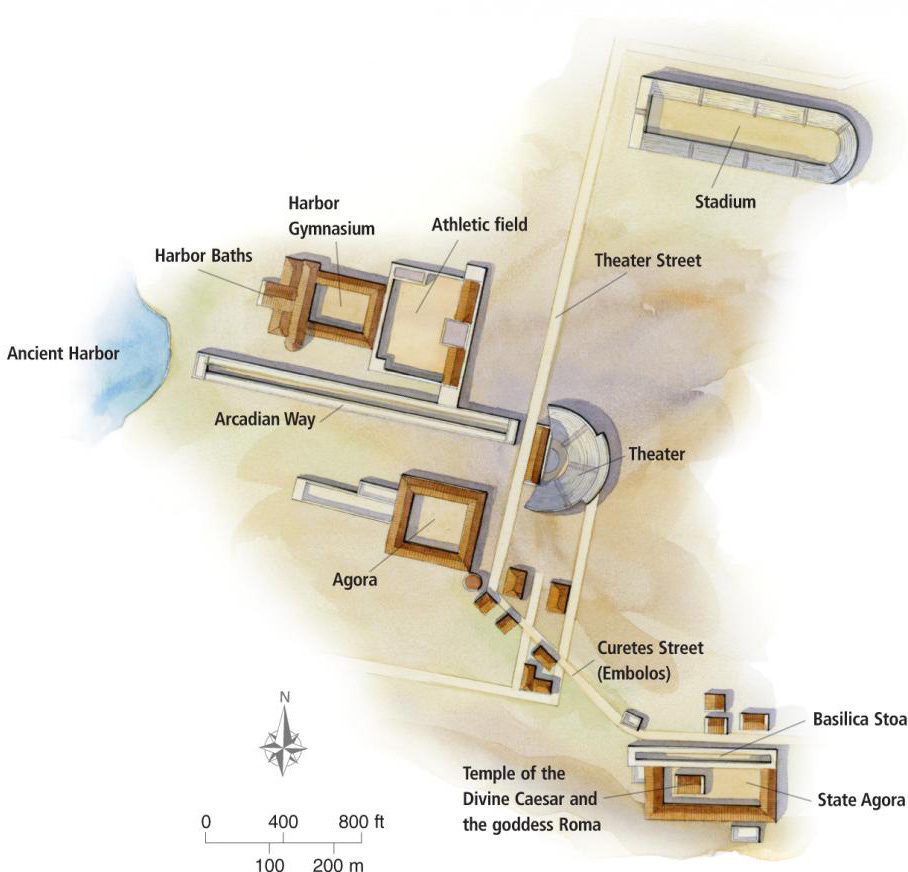
We first encountered the city of Ephesus in the Book of Acts, which I explored in-depth starting in July, 2024 and going forward into February, 2025. Here’s a link to the devotional for the introduction to Acts. Paul spent time there briefly on his first missionary journey and then stayed there for three years on his third missionary journey to help establish the church. He later wrote the letter to this church while under arrest in Rome. As noted in this timeline from Precept Austin it was written at about the same time as Philippians, Colossians and Philemon:

For a another good overview of the Church at Ephesus, this is from Bible Hub:
Historical Context:
The Church at Ephesus was one of the early Christian communities established in the first century AD. Ephesus, a prominent city in the Roman province of Asia (modern-day Turkey), was a major center of commerce and culture. It was renowned for the Temple of Artemis, one of the Seven Wonders of the Ancient World, and was a hub of pagan worship and idolatry. The city's strategic location and bustling port made it an ideal place for the spread of the Gospel.
Founding and Early Development:
The Apostle Paul played a crucial role in the establishment of the Ephesian church. During his second missionary journey, Paul briefly visited Ephesus (Acts 18:19-21). He returned on his third missionary journey and spent approximately three years there, teaching and strengthening the believers (Acts 19:1-10). Paul's ministry in Ephesus was marked by powerful demonstrations of the Holy Spirit, including miracles and the casting out of evil spirits (Acts 19:11-12).
Paul's efforts in Ephesus led to a significant number of conversions, and the Gospel spread throughout the region. The church became a focal point for evangelism and discipleship, with Paul addressing both Jews and Greeks. The impact of the Gospel was so profound that it threatened the local economy, particularly the trade of silver shrines of Artemis, leading to a riot instigated by the silversmith Demetrius (Acts 19:23-41).
Leadership and Correspondence:
The church at Ephesus was blessed with strong leadership. Paul appointed Timothy to oversee the church, providing him with guidance and instructions through the pastoral epistles (1 Timothy 1:3). The Apostle John is also traditionally associated with Ephesus, where he is believed to have lived and ministered in his later years.
Paul's Epistle to the Ephesians, written during his imprisonment in Rome, is a significant New Testament letter that addresses the church. In it, Paul expounds on themes such as the unity of believers, the mystery of the Gospel, and the spiritual blessings in Christ. He encourages the Ephesians to live a life worthy of their calling and to stand firm against spiritual warfare (Ephesians 4:1, 6:10-18).
Commendation and Warning:
The Book of Revelation contains a message from Jesus Christ to the church at Ephesus, delivered through the Apostle John. In Revelation 2:1-7, the church is commended for its hard work, perseverance, and intolerance of false apostles. However, it is also admonished for having forsaken its first love. The Lord calls the Ephesians to remember, repent, and return to the deeds they did at first, warning them of the removal of their lampstand if they fail to do so.
Legacy and DInfluence:
The church at Ephesus played a pivotal role in the early Christian movement. Its strategic location and strong foundation in the teachings of the apostles made it a center for theological development and missionary activity. The challenges faced by the Ephesian church, including false teachings and the need for spiritual vigilance, are instructive for believers throughout the ages.
The legacy of the Ephesian church is a testament to the transformative power of the Gospel in a city steeped in paganism and idolatry. Its account serves as both an encouragement and a cautionary tale for the Church today, emphasizing the importance of maintaining fervent love for Christ and adherence to sound doctrine.
So with the introductions out of the way, my next devotional examines Ephesians 1:1-2 - a greeting from Paul to the faithful at Ephesus.
Heaven on Wheels Daily Prayer:
Dear Lord - Please guide me every day, once again, as I explore one of Your beautiful books of Scripture. Although Ephesians was supposedly written by a human, Paul, Your Spirit guided Paul to his words and purpose. Amen.
Credits and Citations:
Scripture quotations taken from the (NASB®) New American Standard Bible®, Copyright © 1960, 1971, 1977, 1995 by The Lockman Foundation. Used by permission. All rights reserved. www.Lockman.org.
Precept Austin was accessed on 03/13/2026 to review commentary for Ephesians in general.
The Bible Hub was accessed on 03/13/2026 to review commentary about the Church in Ephesus.
Wikipedia was accessed on 03/13/2026 to review the historical perspective of Ephesus.
Commentary from Enduring Word is used with written permission and without any alteration. ©1996-present The Enduring Word Bible Commentary by David Guzik – enduringword.com. Within the Enduring Word commentary:
Bruce, Frederick Fyvie The Epistles to the Colossians, to Philemon, and to the Ephesians (Grand Rapids, Michigan: Eerdmans, 1984)\
Salmond, S.D.F. The Epistle to the Ephesians, The Expositor’s Greek New Testament, Volume III (London: Hodder and Stoughton, ?)
Foulkes, Francis The Epistle of Paul to the Ephesians (Grand Rapids, Michigan: Eerdmans, 1988)
Spurgeon, Charles Haddon The New Park Street Pulpit, Volumes 1-6 and The Metropolitan Tabernacle Pulpit, Volumes 7-63 (Pasadena, Texas: Pilgrim Publications, 1990)