


“Among them we too all formerly lived in the lusts of our flesh, indulging the desires of the flesh and of the mind, and were by nature children of wrath, even as the rest. But God, being rich in mercy, because of His great love with which He loved us, even when we were dead in our transgressions, made us alive together with Christ (by grace you have been saved), and raised us up with Him, and seated us with Him in the heavenly places in Christ Jesus, so that in the ages to come He might show the surpassing riches of His grace in kindness toward us in Christ Jesus.”
Ephesians 2:3-7 NASB1995
This devotional will be published on Easter Sunday. Christ’s great love was supremely demonstrated in the events of Holy Week, particularly on Good Friday (where His grace and lover were seen in His terrible death on the cross for our sins) and Resurrection Sunday, when death was defeated so that we can be raised up with Him and seated in the heavenly places.
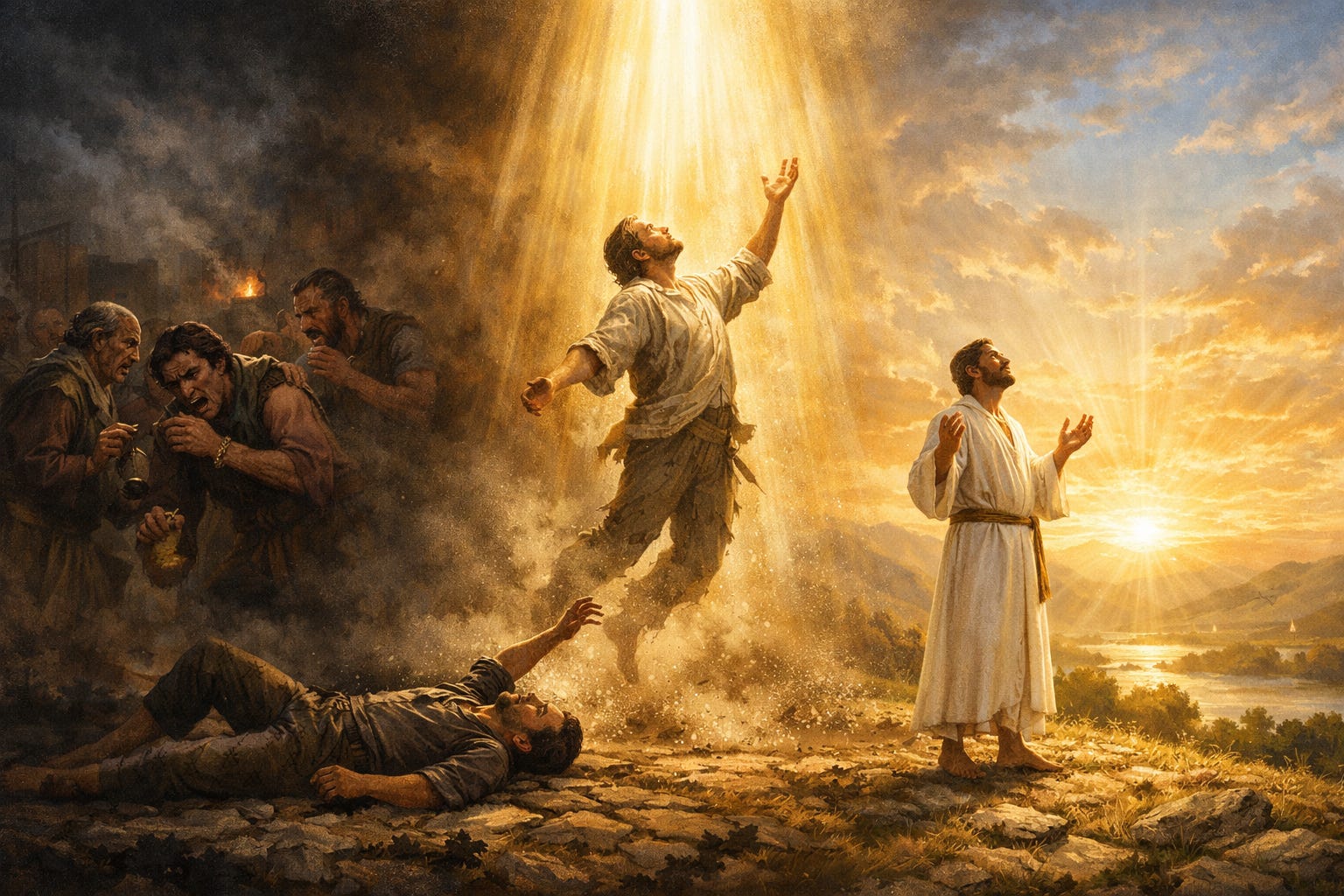
In this devotional, I elected to keep verses 3 through 7 together instead of having one of the awkward breaks in the passage due to a long run-on sentence again. Paul reminds the believers at Ephesus that they, too (and he includes himself) all formerly lived in the lusts of the flesh and of the mind and were by nature children of wrath. In the AI image that Steve asked for, this is represented by the people on the left, indulging in the desires of the flesh and mind. Then there is a transformation, leaving behind the love of sin and degradation and emerging as a Child of God.
It’s not enough to actually indulge in sin physically. Sinners also indulge in lusts of the flesh by thinking about it in their minds. We were children of God’s wrath before our salvation and it still takes God’s power in the Holy Spirit to keep us away from those indulgences, minute by minute in our lives. Our natural state is to be a sinner. This commentary from Precept Austin is quite good (not sure of the source that he is citing):
An elderly Gospel preacher told how he and his wife once went to worship at a certain church, only to discover that the Bible was not believed and taught there. In the Sunday school class the teacher declared that no intelligent person today holds to the obsolete doctrine that people are sinners. He stated that we must not seek the salvation of lost souls, but rather try to improve conditions in general. He asked if any of his audience disagreed. The Bible-believing pastor stood up and announced that he was one of those old-fashioned individuals who still looked upon all human beings as sinners in need of salvation by grace. Turning to the class, he asked, “How many of you had to teach your children to be bad?” Not a hand was raised. Then he inquired, “How many of you had to instruct your children to be good?” Every hand went up. “I have proved my point,” he said. “If children were basically good, they would become evil only if you had trained them in wrongdoing. It is because they are sinners that we must first put so much emphasis upon their need of Christ, and then, even after they are saved, continue diligently to teach them, discipline them, and sometimes chasten them so that they will avoid the evil and do that which is good.”
This faithful servant of God was right. The Bible teaches us that we are born with a sinful nature which we inherit from our parents, and which can be traced back to Adam and Eve. Paul tells believers that before their conversion they were “by nature the children of wrath, even as others” (Eph. 2:3).
Even for Christians it is easy to fall into sinful ways, for they still possess the old Adamic nature. Recognizing this, Paul urged Titus to instruct the believers to whom he ministered concerning Christian conduct. A godly life is not an easy achievement. It is attained only by those who nourish their souls constantly through prayer and the reading of God’s Word.
Human beings are sometimes capable of amazing feats; God gave us intelligence and curiosity. Earlier this week, the Artemis II mission launched with four astronauts who will be doing a free return trajectory around the moon for the first time in over 50 years. I grew up immersed in the Apollo program (I personally witnessed the Apollo 15 launch in Florida in 1971) and I became an engineer because of the remarkable events that occurred with those six landings on the moon and the three missions that were in the vicinity of the moon. I worked in the space business for almost my entire career and am humbled to have been part of excellent teams that have helped explore our solar system and universe and supported our military.

There is ample proof in so many ways that the Apollo missions did exactly what they were supposed to do (land on the moon in different areas, explore it, and collect materials). This proof includes images from lunar orbiting craft that have captured all six landing areas. Sadly, there are more and more people today who doubt that the Apollo landings happened or claim that they were filmed in a studio (in an age that had no computer special effects). These hoaxers, and it seems like they dominate social media, are accusing the hundreds of thousands of people who worked on those missions to be liars. They are also brazenly calling the current mission a hoax! Any evidence that betrays their tightly held beliefs is just part of the hoax. Go look at coverage on social media by major space news sources of Artemis II and see the laughing emojis and read the hysterical comments about the Earth being flat and space exploration being a physical impossibility. I find this to be infuriating, as someone who actually met three of the moonwalkers and spend hours and hours watching coverage and then spent 37 years in the space business, but it is also extremely sad at the same time. I do pray for these people. I found this succinct comment in an editorial I read about this insanity:
Sadly, it appears the true function of social media after two decades is that it has replaced shared facts with personal realities.
In a similar way, more and more people are rejecting the claims of Christianity. God certainly knew what He was doing when the Son of God came to Earth in a time before mass media and the internet; His timing was, of course, perfect. But those clever tools that we smarties use today are the very weapons that the enemy gleefully selects to cast doubt and suspicion on everything. These tools give voice to vast lunatic conspiracies (no pun intended), to holocaust deniers, to child pornographers, to despicable racists, to raging atheists, to people denying their gender, and to people who find Christianity to be an existential threat to their sinful lives. In other words, our connected world accommodates the most depraved natures of the children of wrath, under the evil eye of the “prince of the power of the air”. People are constantly at each other’s throats over every possible (and often tiny) disagreement on every subject under the sun.

BUT the Good News (which is not fake news) is that God is rich in mercy and love and even when we were dead in our transgressions He made us alive together with Christ! We have been saved through grace! Throughout the Bible we encounter these words over and over again: BUT GOD! This is the hope, the past, present, and future of our reconciliation in Him. I really like this answer from Gotquestions.org, on what it means to have a God who is rich in mercy:
In Ephesians 2:4, the apostle Paul writes, “But God, being rich in mercy, because of the great love with which he loved us” (ESV). The word but signals an emphatic contrast between verses 1–3 and verses 4–10. Therefore, to understand the meaning and significance of God’s being “rich in mercy,” we need to review the immediate context.
Ephesians 2:1–3 paints a sobering picture of the human condition. In verse 1, Paul writes that we were “dead” in trespasses and sins. This does not mean that we were physically dead because, in the next verse, he writes that we followed “the course of this world” and “the prince of the power of the air, the spirit that is now at work in the sons of disobedience” (verse 2, ESV). As a result, we “lived in the passions of our flesh, carrying out the desires of the body and the mind, and were by nature children of wrath, like the rest of mankind” (verse 3, ESV).
The contrast between human impoverishment and divine abundance could not be more striking. God is not only merciful; he is “rich in mercy” (Ephesians 2:4). The Greek word for “rich” means that God abounds in mercy. As Jeremiah testified, “The steadfast love of the Lord never ceases; his mercies never come to an end; they are new every morning; great is your faithfulness” (Lamentations 3:22–23, ESV). In other words, God’s mercy is overwhelmingly generous. We do not deserve it, yet He continues to give it. How great is our God!
Even when we were dead in trespasses and sins, God was still merciful to us “because of his great love for us” (Ephesians 2:4). God’s love is more than sentimental feelings; it is a love that moved Him to action: “For God so loved the world, that he gave his only Son, that whoever believes in him should not perish but have eternal life” (John 3:16, ESV; cf. Romans 5:8). God loved us so much that He gave His only Son for us. Now, that is true and unconditional love!
We have been raised up with Him!

Tomorrow we celebrate the Resurrection of our Lord and our certainty of eternal life. He conquered death, yet He still bears the scars of the Crucifixion. In this ridiculous age of armchair experts, conspiracists, and professional deniers, how do we know the Resurrection is true? I like this answer on five lines of evidence from Gotquestions.org:
The First Line of Evidence for Christ’s resurrection
To begin with, we have demonstrably sincere eyewitness testimony. Early Christian apologists cited hundreds of eyewitnesses, some of whom documented their own alleged experiences. Many of these eyewitnesses willfully and resolutely endured prolonged torture and death rather than repudiate their testimony. This fact attests to their sincerity, ruling out deception on their part. According to the historical record (Acts 4:1-17; Pliny’s Letters to Trajan, X.97, etc.) most Christians could end their suffering simply by renouncing the faith. Instead, it seems that most opted to endure the suffering and proclaim Christ’s resurrection unto death.
Granted, while martyrdom is remarkable, it is not necessarily compelling. It does not validate a belief so much as it authenticates a believer (by demonstrating his or her sincerity in a tangible way). What makes the earliest Christian martyrs remarkable is that they knew whether or not what they were professing was true. They either saw Jesus Christ alive-and-well after His death or they did not. This is extraordinary. If it was all just a lie, why would so many perpetuate it given their circumstances? Why would they all knowingly cling to such an unprofitable lie in the face of persecution, imprisonment, torture, and death?
While the September 11, 2001, suicide hijackers undoubtedly believed what they professed (as evidenced by their willingness to die for it), they could not and did not know if it was true. They put their faith in traditions passed down to them over many generations. In contrast, the early Christian martyrs were the first generation. Either they saw what they claimed to see, or they did not.
Among the most illustrious of the professed eyewitnesses were the Apostles. They collectively underwent an undeniable change following the alleged post-resurrection appearances of Christ. Immediately following His crucifixion, they hid in fear for their lives. Following the resurrection they took to the streets, boldly proclaiming the resurrection despite intensifying persecution. What accounts for their sudden and dramatic change? It certainly was not financial gain. The Apostles gave up everything they had to preach the resurrection, including their lives.
The Second Line of Evidence for Christ’s resurrection
A second line of evidence concerns the conversion of certain key skeptics, most notably Paul and James. Paul was of his own admission a violent persecutor of the early Church. After what he described as an encounter with the resurrected Christ, Paul underwent an immediate and drastic change from a vicious persecutor of the Church to one of its most prolific and selfless defenders. Like many early Christians, Paul suffered impoverishment, persecution, beatings, imprisonment, and execution for his steadfast commitment to Christ’s resurrection.
James was skeptical, though not as hostile as Paul. A purported post-resurrection encounter with Christ turned him into an inimitable believer, a leader of the Church in Jerusalem. We still have what scholars generally accept to be one of his letters to the early Church. Like Paul, James willingly suffered and died for his testimony, a fact which attests to the sincerity of his belief (see Acts and Josephus’ Antiquities of the Jews, XX.ix.1).
The Third and Fourth Lines of Evidence for Christ’s resurrection
A third line and fourth line of evidence concern enemy attestation to the empty tomb and the fact that faith in the resurrection took root in Jerusalem. Jesus was publicly executed and buried in Jerusalem. It would have been impossible for faith in His resurrection to take root in Jerusalem while His body was still in the tomb where the Sanhedrin could exhume it, put it on public display, and thereby expose the hoax. Instead, the Sanhedrin accused the disciples of stealing the body, apparently in an effort to explain its disappearance (and therefore an empty tomb). How do we explain the fact of the empty tomb? Here are the three most common explanations:
First, the disciples stole the body. If this were the case, they would have known the resurrection was a hoax. They would not therefore have been so willing to suffer and die for it. (See the first line of evidence concerning demonstrably sincere eyewitness testimony.) All of the professed eyewitnesses would have known that they hadn’t really seen Christ and were therefore lying. With so many conspirators, surely someone would have confessed, if not to end his own suffering then at least to end the suffering of his friends and family. The first generation of Christians were absolutely brutalized, especially following the conflagration in Rome in AD 64 (a fire which Nero allegedly ordered to make room for the expansion of his palace, but which he blamed on the Christians in Rome in an effort to exculpate himself). As the Roman historian Cornelius Tacitus recounted in his Annals of Imperial Rome (published just a generation after the fire):
Nero fastened the guilt and inflicted the most exquisite tortures on a class hated for their abominations, called Christians by the populace. Christus, from whom the name had its origin, suffered the extreme penalty during the reign of Tiberius at the hands of one of our procurators, Pontius Pilatus, and a most mischievous superstition, thus checked for the moment, again broke out not only in Judaea, the first source of the evil, but even in Rome, where all things hideous and shameful from every part of the world find their centre and become popular. Accordingly, an arrest was first made of all who pleaded guilty; then, upon their information, an immense multitude was convicted, not so much of the crime of firing the city, as of hatred against mankind. Mockery of every sort was added to their deaths. Covered with the skins of beasts, they were torn by dogs and perished, or were nailed to crosses, or were doomed to the flames and burnt, to serve as a nightly illumination, when daylight had expired. (Annals, XV:44)
Nero illuminated his garden parties with Christians whom he burnt alive. Surely someone would have confessed the truth under the threat of such terrible pain. The fact is, however, we have no record of any early Christian denouncing the faith to end his suffering. Instead, we have multiple accounts of post-resurrection appearances and hundreds of eyewitnesses willing to suffer and die for it.
If the disciples didn’t steal the body, how else do we explain the empty tomb? Some have suggested that Christ faked His death and later escaped from the tomb. This is patently absurd. According to the eyewitness testimony, Christ was beaten, tortured, lacerated, and stabbed. He suffered internal damage, massive blood loss, asphyxiation, and a spear through His side. There is no good reason to believe that Jesus Christ (or any other man for that matter) could survive such an ordeal, fake His death, sit in a tomb for three days and nights without medical attention, food or water, remove the massive stone which sealed His tomb, escape undetected (without leaving behind a trail of blood), convince hundreds of eyewitnesses that He was resurrected from the death and in good health, and then disappear without a trace. Such a notion is ridiculous.
The Fifth Line of Evidence for Christ’s resurrection
Finally, a fifth line of evidence concerns a peculiarity of the eyewitness testimony. In all of the major resurrection narratives, women are credited as the first and primary eyewitnesses. This would be an odd invention since in both the ancient Jewish and Roman cultures women were severely disesteemed. Their testimony was regarded as insubstantial and dismissible. Given this fact, it is highly unlikely that any perpetrators of a hoax in first century Judea would elect women to be their primary witnesses. Of all the male disciples who claimed to see Jesus resurrected, if they all were lying and the resurrection was a scam, why did they pick the most ill-perceived, distrusted witnesses they could find?
Dr. William Lane Craig explains, “When you understand the role of women in first-century Jewish society, what’s really extraordinary is that this empty tomb story should feature women as the discoverers of the empty tomb in the first place. Women were on a very low rung of the social ladder in first-century Israel. There are old rabbinical sayings that said, ‘Let the words of Law be burned rather than delivered to women’ and ‘blessed is he whose children are male, but woe to him whose children are female.’ Women’s testimony was regarded as so worthless that they weren’t even allowed to serve as legal witnesses in a Jewish court of Law. In light of this, it’s absolutely remarkable that the chief witnesses to the empty tomb are these women.... Any later legendary account would have certainly portrayed male disciples as discovering the tomb—Peter or John, for example. The fact that women are the first witnesses to the empty tomb is most plausibly explained by the reality that—like it or not—they were the discoverers of the empty tomb! This shows that the Gospel writers faithfully recorded what happened, even if it was embarrassing. This bespeaks the historicity of this tradition rather than its legendary status” (Dr. William Lane Craig, quoted by Lee Strobel, The Case For Christ, Zondervan, 1998, p. 293).
This is a great summary of the evidence for His Resurrection. Scoffers and doubters can probably poke holes in it as they will in anything, gleefully doing the enemy’s work. BUT just as I KNOW that there were six lunar landings during the Apollo program because I am an eyewitness to those events and I became personally familiar with the details and some of the people involved, I also KNOW that the overwhelming evidence of the most important historical event in Earth’s history is also true. Reading and studying and writing about the details in scripture and being faithful in prayer destroy doubt. Knowledge of His Word and promises is powerful; willful ignorance is one of the worst sins.
My next devotional examines a beautiful passage in Ephesians 2:8-10 - For it is by grace that you are saved.
Heaven on Wheels Daily Prayer:
Dear Lord - I thank you for the creativity and intelligence that You have given to humans. I pray that creativity and intelligence are used to serve Your purposes. I am grateful that I am able to avoid falling into conspiracy traps and endless bickering on reality. Amen.
Citations and Credits:
Scripture quotations taken from the (NASB®) New American Standard Bible®, Copyright © 1960, 1971, 1977, 1995 by The Lockman Foundation. Used by permission. All rights reserved. www.Lockman.org.
Precept Austin was accessed on 04/04/25 to review commentary for Ephesians 1:20-23. Within the Precept Austin commentary was a link to Gotquestions.org to answer the question, How is the church the Body of Christ? © COPYRIGHT 2002-2026 GOT QUESTIONS MINISTRIES. ALL RIGHTS RESERVED
Gotquestions.org was also accessed independently on 04/04/25 to answer the question, Why should I believe in Christ’s resurrection? © COPYRIGHT 2002-2026 GOT QUESTIONS MINISTRIES. ALL RIGHTS RESERVED
Commentary from Enduring Word is used with written permission and without any alteration. ©1996-present The Enduring Word Bible Commentary by David Guzik – enduringword.com. Enduring Word commentary was not used in this devotional.
What does it mean that God is rich in mercy (Ephesians 2:4)?https://www.gotquestions.org/rich-in-mercy.html
HE IS RISEN🙌🙌🙌