


“He predestined us to adoption as sons through Jesus Christ to Himself, according to the kind intention of His will, to the praise of the glory of His grace, which He freely bestowed on us in the Beloved.”
Ephesians 1:5-6 NASB1995
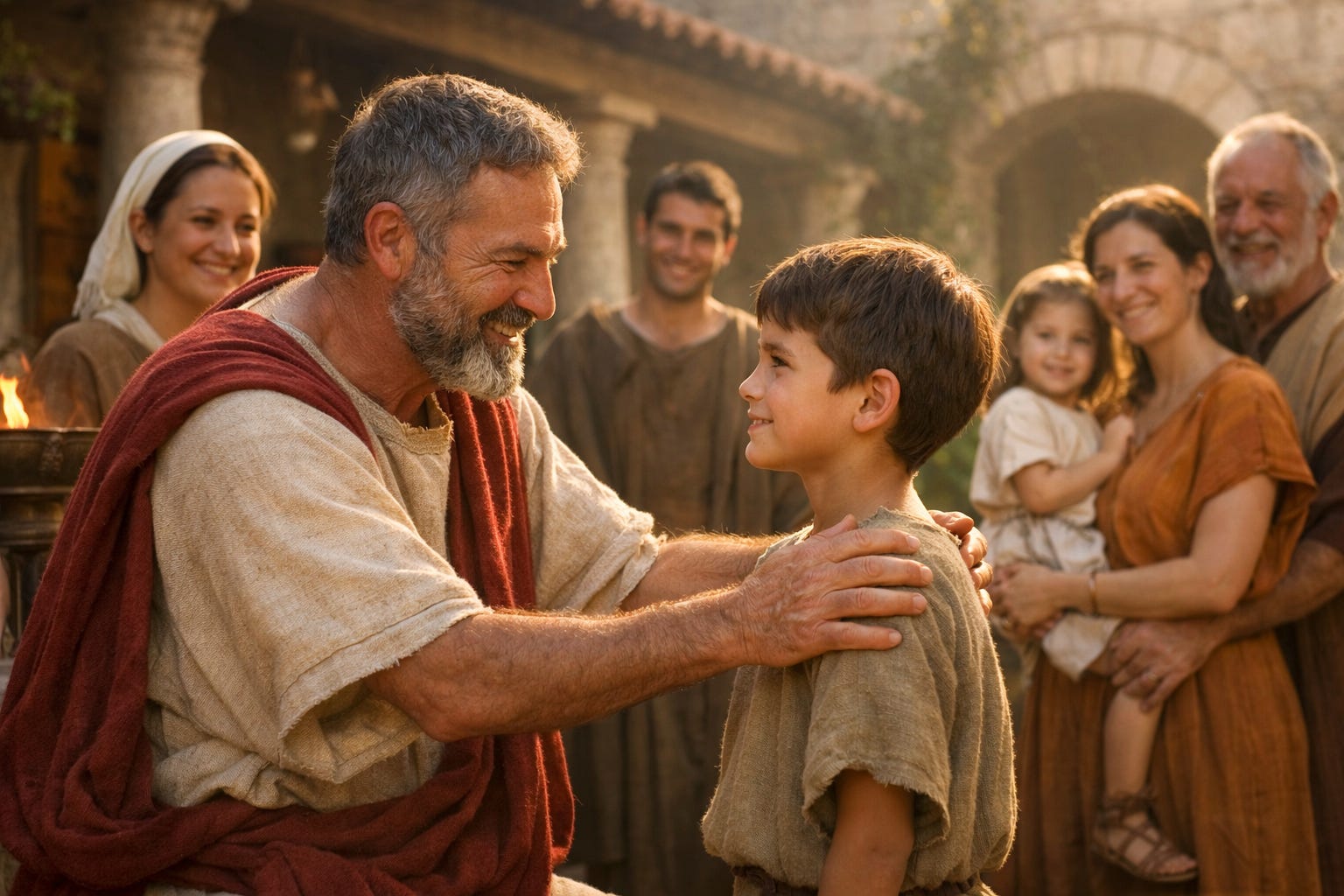
Adoption in the Greco-Roman days was an important process. Powerful men without a male heir could adopt a relative or even a slave and instantly turn that child (or adult) into a beloved son. This theme was explored in the splendid book by General Lew Wallace (a veteran of the Civil War) and the 1959 award-winning film “Ben Hur”. The title character, Judah Ben-Hur, who is working as a galley slave, rescues a wealthy and powerful Roman Consul (Arrius Quintus) when their ship is sunk. He is adopted into the family with all of the rights and privileges. The AI image for today (above) looks at this theme of adoption during those times. Just a reminder: We do not use AI for anything in these devotionals except images.
We are also predestined to adoption as sons (and daughters) through Jesus Christ to Himself. This is the kind intention of God’s will and grace, which is freely bestowed on us! This commentary from Enduring Word is quite good:
f. Having predestined us to adoption as sons by Jesus Christ to Himself: This is the Father’s destiny for His chosen – that they would enjoy adoption as sons. God’s unfolding plan for us not only includes salvation and personal transformation, but also a warm, confident relationship with the Father.
i. In Roman law, “When the adoption was complete it was complete indeed. The person who had been adopted had all the rights of a legitimate son in his new family and completely lost all rights in his old family. In the eyes of the law he was a new person. So new was he that even all debts and obligations connected with his previous family were abolished as if they had never existed.” (Barclay)
ii. Gaebelein takes the thought even further: “Believers in the Lord Jesus Christ are not adopted into the family of God; they are born into the family. The Greek has only one word ‘Sonplace.’ We are placed into the position of Sons.”
iii. This high position in the family of God gives us something in Jesus that Adam never had. “When people ask us the speculative question why God went ahead with the creation when he knew that it would be followed by the fall, one answer we can tentatively give is that he destined us for a higher dignity than even creation would bestow on us.” (Stott)
g. To the praise of the glory of His grace, by which He has made us accepted in the Beloved: The relational aspect is emphasized again as Paul describes the status of accepted (charito, “highly favored” or “full of grace” as in Luke 1:28) that is granted to every believer because of God’s grace.
i. Jesus was completely accepted by the Father. All His character, all His words, all His work was acceptable to God the Father. And now we are accepted in the Beloved.
ii. Paul realized this plan gave glory to the grace of God. “By the giving of the LAW, God’s justice and holiness were rendered most glorious; by the giving of the GOSPEL, his grace and mercy are made equally glorious.” (Clarke) God’s plan in the gospel is often rejected because it glorifies God and His grace and not the effort or achievement of man.
iii. Bruce on the idea of being accepted by God on the standing of grace: “God’s grace has extended to his people and enfolded them: he has ‘be-graced’ them, says Paul (using a verb derived from the Greek word for ‘grace’).”
iv. Chrysostom, speaking of the work by which God makes us accepted in the Beloved: “It is as if one were to take a leper and change him into a lovely youth.”
Key takeaways:
The adopted son under Roman law became a new person. We become new persons under the grace of our savior Jesus! All debts (sins) are abolished as if they never existed.
We have something in Jesus that Adam never had. John Stott’s comment in this commentary is worth reading again: “When people ask us the speculative question why God went ahead with the creation when he knew that it would be followed by the fall, one answer we can tentatively give is that he destined us for a higher dignity than even creation would bestow on us.”
Jesus was God’s beloved Son and completely accepted by the Father. And we are accepted through His Beloved. We have been “Be-graced”.

It’s probably worth looking at another Gotquestions.org article on the idea of predestination, as I used them to answer the question about being chosen before the foundation of the world. This concept is considered controversial and many people, especially in our time of willful entitlement, would consider it “unfair”. Let’s take a look at their answer as to whether it is Biblical or not:
Romans 8:29-30 tells us, “For those God foreknew he also predestined to be conformed to the likeness of his Son, that he might be the firstborn among many brothers. And those he predestined, he also called; those he called, he also justified; those he justified, he also glorified.” Ephesians 1:5 and 11 declare, “He predestined us to be adopted as his sons through Jesus Christ, in accordance with his pleasure and will…In him we were also chosen, having been predestined according to the plan of him who works out everything in conformity with the purpose of his will.” Many people have a strong hostility to the doctrine of predestination. However, predestination is a biblical doctrine. The key is understanding what predestination means, biblically.
The words translated “predestined” in the Scriptures referenced above are from the Greek word proorizo, which carries the meaning of “determining beforehand,” “ordaining,” “deciding ahead of time.” So, predestination is God determining certain things to occur ahead of time. What did God determine ahead of time? According to Romans 8:29-30, God predetermined that certain individuals would be conformed to the likeness of His Son, be called, justified, and glorified. Numerous scriptures refer to believers in Christ being chosen (Matthew 24:22, 31; Mark 13:20, 27; Romans 8:33, 9:11, 11:5-7, 28; Ephesians 1:11; Colossians 3:12; 1 Thessalonians 1:4; 1 Timothy 5:21; 2 Timothy 2:10; Titus 1:1; 1 Peter 1:1-2, 2:9; 2 Peter 1:10). Predestination is the biblical doctrine that God in His sovereignty chooses certain individuals to be saved.
Predestination is an explicitly biblical doctrine. Yet the determination of predestination is not disconnected from the rest of God’s unchanging character (Malachi 3:6). It is connected to His foreknowledge (Romans 8:29, 11:2), His love (Ephesians 1:4-5), and His plan and pleasure (Ephesians 1:5). God’s desire is that all would be saved and come to repentance (1 Timothy 2:4, 2 Peter 3:9). Predestination is personal and relational, not capricious.
The most common objection to the doctrine of predestination is that it is unfair. Why would God choose certain individuals and not others? We must remember that no one deserves to be saved. We have all sinned (Romans 3:23) and are all worthy of eternal punishment (Romans 6:23). As a result, God would be perfectly just in allowing all of us to spend eternity in hell. However, God chooses to save some of us. He is not being unfair to those who are not chosen, because they are receiving what they deserve. God’s choosing to be gracious to some is not unfair to the others. No one deserves anything from God; therefore, no one can object if he does not receive anything from God. An illustration would be a man randomly handing out money to five people in a crowd of twenty. Would the fifteen people who did not receive money be upset? Probably so. Do they have a right to be upset? No, they do not. Why? Because the man did not owe anyone money. He simply decided to be gracious to some.
If God is choosing who is saved, doesn’t that undermine our free will to choose and believe in Christ? The Bible says that we have the choice—all who believe in Jesus Christ will be saved (John 3:16; Romans 10:9-10). The Bible never describes God rejecting anyone who believes in Him or turning away anyone who is seeking Him (Deuteronomy 4:29). The truths of God’s sovereign predestination and also man’s responsibility are not mutually exclusive. Somehow, in the mystery of God, predestination works hand-in-hand with a person being drawn by God (John 6:44) and believing unto salvation (Romans 1:16). God predestines who will be saved, and we must choose Christ in order to be saved. Both facts are equally true. Romans 11:33 proclaims, “Oh, the depth of the riches of the wisdom and knowledge of God! How unsearchable his judgments, and his paths beyond tracing out!”
That is a pretty good answer, to go along with the one I shared in the last devotional. God is sovereign and His judgments are unsearchable and His paths are beyond tracing out, as Romans 11 states. We deserve nothing (or worse) if we don’t choose Him! As the article states: God predestines who will be saved, and we must choose Christ in order to be saved. Both facts are equally true.
My next devotional examines Ephesians 1:7 - In Him we have redemption through His blood.
Heaven on Wheels Daily Prayer:
Dear Lord - Thank You so much for adopting me as Your child! Amen!
Credits and Citations:
Scripture quotations taken from the (NASB®) New American Standard Bible®, Copyright © 1960, 1971, 1977, 1995 by The Lockman Foundation. Used by permission. All rights reserved. www.Lockman.org.
Precept Austin was accessed on 03/19/2026 to review commentary for Ephesians 1:5-6. Within the Precept Austin commentary was a link to Gotquestions.org: Gotquestions.org was accessed to answer this question: What is predestination? Gotquestions.org Copyright © 2026 all rights reserved.
Commentary from Enduring Word is used with written permission and without any alteration. ©1996-present The Enduring Word Bible Commentary by David Guzik – enduringword.com. Within the Enduring Word commentary:
Barclay, William The Letters to the Galatians and the Ephesians (Philadelphia: Westminster Press, 1975)
Gaebelein, Arno C. God’s Masterpiece (Glasgow: Pickering and Inglis, 1913)
Stott, John R.W. God’s New Society, The Message of Ephesians (Downer’s Grove, Illinois: InterVarsity Press, 1979)
Bruce, Frederick Fyvie The Epistles to the Colossians, to Philemon, and to the Ephesians (Grand Rapids, Michigan: Eerdmans, 1984)
I study with Muslims every day. They often quote the Qur'an and declare, "God needs no partners, God has no wife, God has no son!' I always reply, "If you become a Christian, you, too, will be God's son." That really shocks and puts them to thinking.
Barb, keep in mind that this comment of mine is coming from me and not some theologian.
I actually try not to concern myself with predestination because I find this similar to Mathew 20:1-16.
I think the lesson for me is that it is interesting we want to say how unfair something is. It shows our pride of being more concerned that someone else is getting something that we aren’t. Instead we should be thinking of how undeserving we are of anything, and be praising God that he loves us despite that.
Then come and be thankful that God also cares and loves others.
We need to focus on the Love and grace of our savior and not on when and what some others receive.