



“For this reason I bow my knees before the Father, from whom every family in heaven and on earth derives its name, that He would grant you, according to the riches of His glory, to be strengthened with power through His Spirit in the inner man, so that Christ may dwell in your hearts through faith; and that you, being rooted and grounded in love, may be able to comprehend with all the saints what is the breadth and length and height and depth, and to know the love of Christ which surpasses knowledge, that you may be filled up to all the fullness of God.”
Ephesians 3:14-19 NASB1995
Paul now begins his second prayer in Ephesians. This passage is very rich in content, with a lot to unpack. As a comparison of the two prayers, here’s a table from Precept Austin comparing the content of the prayer in Ephesians 1 with this prayer:
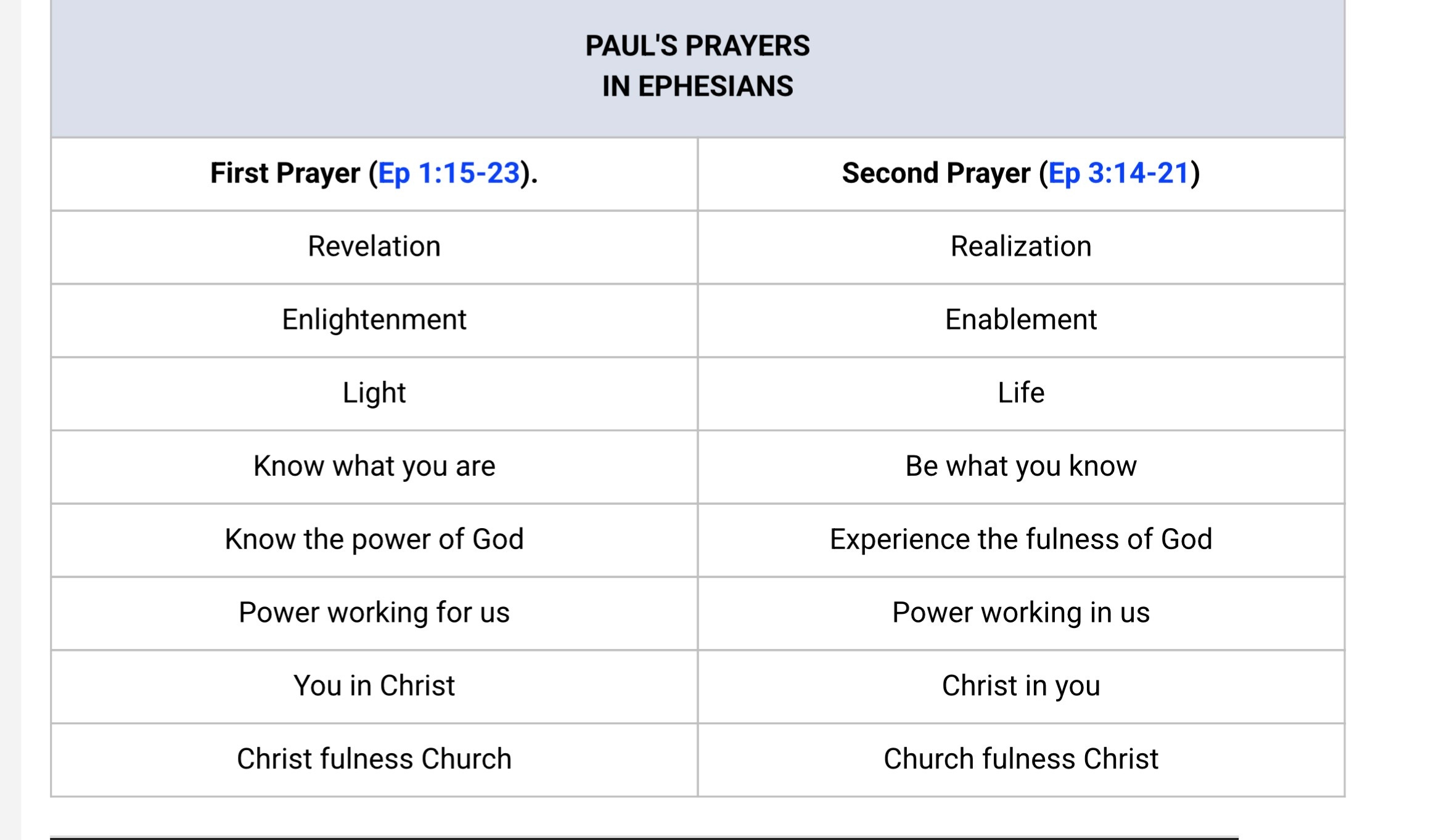
“Fulness” is not misspelled, by the way, but is an alternate spelling that has spiritual context. Here is an AI search request result on this term:
Fulness refers to a state of being filled or complete, often used in a spiritual or emotional context. In Christianity, it can denote the completeness of God’s presence or the fullness of grace in Christ. wisdomlib.org, Bible Study Tools
Paul bows his knees before the Father, from whom every family in heaven and on earth derives its name. What does this mean? The commentary from Enduring Word is somewhat helpful:
c. To the Father of our Lord Jesus Christ: Paul directed his prayer to the Father, who is presented as the “planner” among the members of the Trinity. In the Bible, prayer is usually directed to the Father, through the Son, by the empowering and direction of the Holy Spirit.
d. From whom the whole family in heaven and earth is named: In remembering that all God’s family is called after His name, Paul showed that his mind was rather taken with this idea of the essential unity of the Body of Christ. God is Father of both Jew and Gentile.
i. Charles Spurgeon preached a touching sermon on this verse titled, Saints in Heaven and Earth One Family. In it he developed the idea that we are one with our brothers and sisters in heaven, and how this enriches our hope of heaven.
ii. Some commentators think Paul refers to heavenly families in the sense of families of angels. “May not the holy Angels be bound up in spiritual families, though they marry not nor are given in marriage?” (Alford)
The Spurgeon sermon referenced in this commentary can be found at this link. It is a indeed a beautiful sermon and this is how the sermon ends:
If we do belong to the family let it[s] show [in] our relationship by loving all the members of it. I should not like a brother to be gone to heaven and to reflect that I was unkind to him; I should not like to think that I might have smoothed his pathway, and I did not; or I might have cheered him, and refused. Dear brethren, we shall live together in heaven for ever, let us love each other now with a pure heart fervently. Help your poor brethren, cheer your desponding sisters; let no man look only on his own things, but every man also on the things of others. Brother, be brotherly; sister, be a true sister. Let us not love in word only, but in deed and in truth, for we shall soon be at home together in our Father’s house on high.
That’s a profound idea - we might shun or scorn or ignore another believer in this life because we find them to “be a pain” or difficult to understand or please, but guess what? We will share eternity with them so we should love them in deed and in truth.

Paul prays that we would be strengthened in power through His Spirit to the inner man (or woman), so that Christ may dwell in our hearts through faith. This enables us to comprehend with all the saints the length, breadth, height and depth of the love of Christ, which still surpasses knowledge.
Enduring Word has excellent commentary; this is, by the way, the best commentary I read that describes this surpassing love of Christ:
a. To be strengthened with might through His Spirit in the inner man: Paul asked that they would be strengthened with might, and that the strength would be according to the riches of His glory (a most generous measure). He also prayed that the strength would come through the Holy Spirit and that it would be put into their inner man.
i. There is an inner man just as real as our physical body. We all understand the importance of strength in our physical body, but many are exceedingly weak in the inner man.
ii. According to the riches of His glory: “It would be a disgrace to a king or a nobleman to give no more than a tradesman or a peasant. God acts up to the dignity of his infinite perfections; he gives according to the riches of his glory.” (Clarke)
b. That Christ may dwell in your hearts through faith: Paul asked that Jesus would live in these believers, even as Jesus promised in John 14:23: If anyone loves Me, he will keep My word; and My Father will love him, and We will come to him and make Our home with him.
i. Two ancient Greek words convey the idea “to live in.” One has the idea of living in a place as a stranger, and the other has the idea of settling down in a place to make it your permanent home. Dwell uses the ancient Greek word for a permanent home. Jesus wants to settle down in your heart, not just visit as a stranger.
ii. The glory of the indwelling Jesus is something for us to know, and to know by faith. It is there for us, but must be taken hold of through faith. “You have your Bible, and you have your knees; use them.” (Carr John Glynn, godfather to H. C. G. Moule)
iii. We need spiritual strength to let Christ dwell within us because there is something in us that resists the influence of the indwelling Jesus. That something can be conquered as the Spirit of God gives us the victory of faith.
…
e. What is the width and length and depth and height: This means that the love of Jesus has dimensions and that it can be measured.
i. “Alas, to a great many religious people the love of Jesus is not a solid substantial thing at all – it is a beautiful fiction, a sentimental belief, a formal theory, but to Paul it was a real, substantial, measurable fact; he had considered it this way, and that way, and the other way, and it was evidently real to him, whatever it might be to others.” (Spurgeon)
ii. The love of Jesus has width. You can see how wide a river is by noticing how much it covers over. God’s river of love is so wide that it covers over my sin, and it covers over every circumstance of my life, so that all things work together for good. When I doubt His forgiveness or His providence, I am narrowing the mighty river of God’s love. His love is as wide as the world: For God so loved the world (John 3:16).
iii. “Some of them seem to be so taken up with the height and length that they deny the breadth, and you would think from hearing them preach that Christ came into the world to save half-a-dozen, and that they were five of them… Out on their narrowness! There will be more in heaven than we expect to see there by a long way; and there will be some there with whom we had very little comfortable fellowship on earth who had fellowship with Christ, and who are therefore taken to dwell with him for ever.” (Spurgeon)
iv. The love of Jesus has length. When considering the length of God’s love, ask yourself, “When did the love of God start towards me? How long will it continue?” These truths measure the length of God’s love. Yes, I have loved you with an everlasting love (Jeremiah 31:3).
v. The love of Jesus has depth. Philippians 2:7-8 tell us how deep the love of Jesus goes: but made Himself of no reputation, taking the form of a bondservant, and coming in the likeness of men. And being found in appearance as a man, He humbled Himself and became obedient to the point of death, even the death of the cross. You can’t go lower than the death of the cross, and that is how deep the love of Jesus is for us.
vi. The love of Jesus has height. To see the height of God’s love, ask yourself, “How high does it lift me?” It lifts me to heavenly places where I am seated with Christ. He has raised us up together, and made us sit together in the heavenly places in Christ Jesus (Ephesians 2:6).
vii. Can we really comprehend the width and length and depth and height of God’s love? To come to any understanding of the dimensions of God’s love, we must come to the cross. The cross pointed in four ways, essentially in every direction, because…
· God’s love is wide enough to include every person.
· God’s love is long enough to last through all eternity.
· God’s love is deep enough to reach the worst sinner.
· God’s love is high enough to take us to heaven.
f. To know the love of Christ: Paul wrote of something we can know. This isn’t speculation, guesswork, emotions, or feelings. This is something to know.
i. “One of these philosophers kindly says that religion is a matter of belief; not of knowledge. This is clean in opposition to all the teaching of Scripture.” (Spurgeon)
A few key takeaways:
The inner man (or woman) is as real as our physical body. We may be strong physically but weak in our inner and essential self.
Christ dwells in our hearts and wants this to be a permanent home, not a temporary dwelling.
The width, depth, height and length of Christ’s love overwhelms us. As Spurgeon noted, there will be many more people in heaven than we surmise including some that may surprise us (and our presence may surprise others).
The cross is pointed in four directions showing the magnitude of Christ’s love. I really like this analogy that Guzik uses to show us something that we know - His love is a matter of knowledge, not belief!
The four dimensions of Christ’s love are embedded in the foundation of our inner strength that comes from Him and stretch across the dimension of time as well to eternity.
One more story about this strength that comes from the Lord; this one was found in Precept Austin (the links go to commentary on Proverbs 18:10):
In 1934, when Adolf Hitler summoned German church leaders to his Berlin office to berate them for insufficiently supporting his programs, he was surprised when Pastor Martin Niemoller stood up to him. That evening his Gestapo raided Niemoller’s rectory, and a few days later a bomb exploded in his church. He was later arrested and placed in solitary confinement. Dr. Niemoller’s trial began on February 7, 1938. That morning, a green-uniformed guard escorted the minister from his prison cell and through a series of underground passages toward the courtroom. Niemoller was overcome with terror and loneliness. What would become of him? Of his family? His church? The guard’s face was impassive, but as they exited a tunnel to ascend a final flight of stairs, Niemoller heard a whisper. At first he didn’t know where it came from, for the voice was soft as a sigh. Then he realized that the officer was breathing into his ear the words of Proverbs 18:10 (commentary): “The name of the Lord is a strong tower The righteous run to it and are safe.” Niemoller’s fear fell away, and the power of that verse sustained him through his trial and his years in Nazi concentration camps.
My next devotional examines Ephesians 3:20-21 - A doxology.
Heaven on Wheels Daily Prayer:
Dear Lord - I know that Your love surpasses any fears and is embedded in the foundation of our inner selves. Amen.
Citations and Credits:
Scripture quotations taken from the (NASB®) New American Standard Bible®, Copyright © 1960, 1971, 1977, 1995 by The Lockman Foundation. Used by permission. All rights reserved. www.Lockman.org.
Precept Austin was accessed on 04/24/2026 to review commentary for Ephesians 3:14-19. This commentary included a link to this Charles Spurgeon sermon: https://www.spurgeon.org/resource-library/sermons/saints-in-heaven-and-earth-one-family/#flipbook/
Commentary from Enduring Word is used with written permission and without any alteration. ©1996-present The Enduring Word Bible Commentary by David Guzik – enduringword.com. Within that commentary are the following references:
Alford, Henry The New Testament for English Readers, Volume II, Part I (London: Rivingtons, 1869)
Clarke, Adam The New Testament with A Commentary and Critical Notes, Volume II (New York: Eaton & Mains, 1831)
Moule, Handley C. G. Ephesian Studies (London: Pickering and Inglis, ?)
Spurgeon, Charles Haddon The New Park Street Pulpit, Volumes 1-6 and The Metropolitan Tabernacle Pulpit, Volumes 7-63 (Pasadena, Texas: Pilgrim Publications, 1990)
Ephesians 3 is my favorite chapter of my favorite book in the NT.
Paul, the second most important figure in the history of Christianity.