


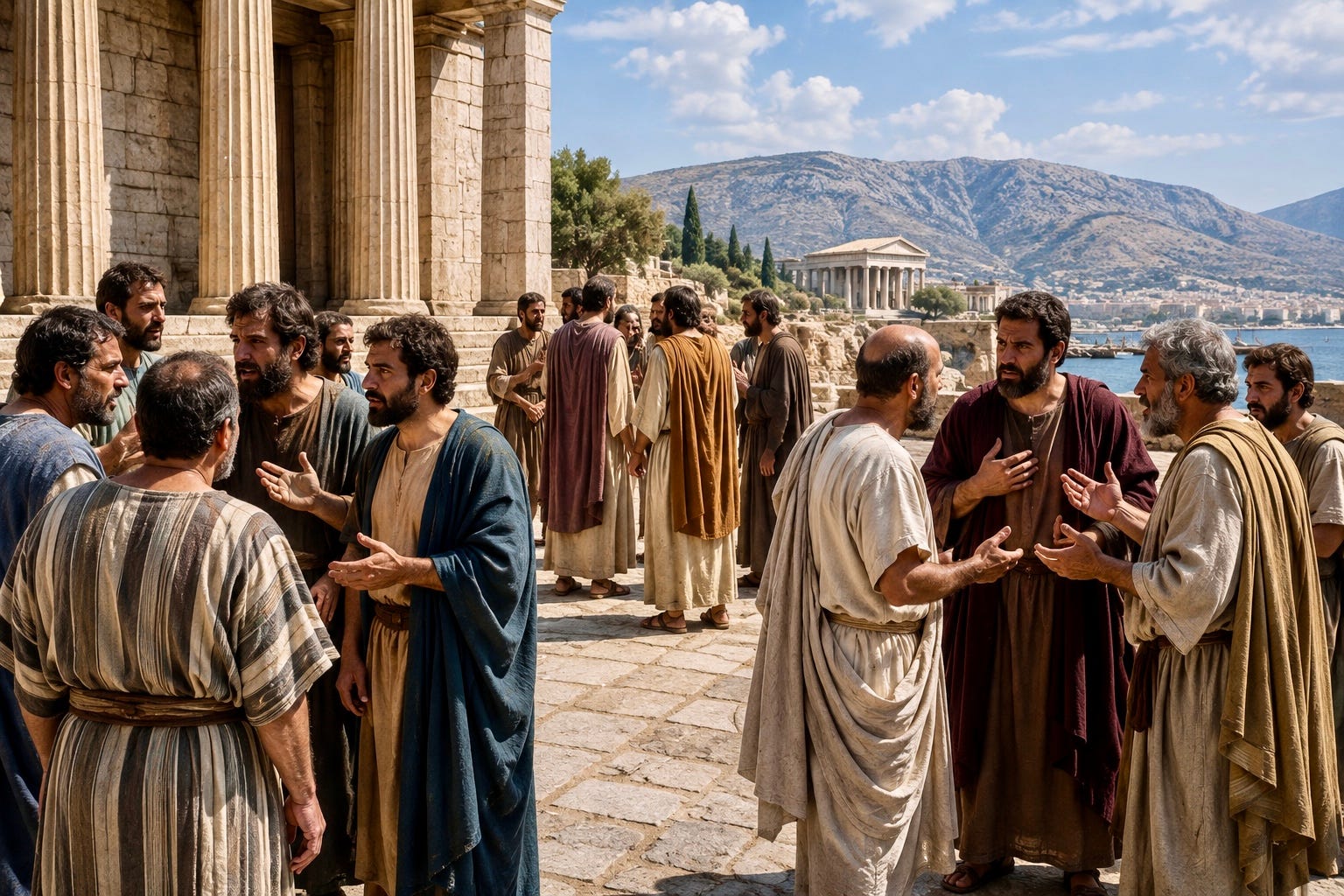
Image generated by ChatGPT (OpenAI) using the DALL·E model.
“I appeal to you, brothers and sisters, in the name of our Lord Jesus Christ, that all of you agree with one another in what you say and that there be no divisions among you, but that you be perfectly united in mind and thought.”
1 Corinthians 1:10 NIV
Paul wrote his First Epistle to the Corinthians with two goals in mind: First, he needed to heal deep divisions between rival factions within the church (sounds familiar even today!). Second, he had to address the rampant immorality practiced by many of the church members.
In this verse he’s attempting to address the first, and probably most critical, issue. If he could successfully rally the church leaders to resolve their differences and dedicate themselves to one thing — preaching the unadulterated Gospel of Christ — all other issues would be much easier to clear up.
Here’s what the infighting in the church of Corinth is all about (from The Bible Says):
Having directed their minds to the good gifts they have received from their faithful God, Paul exhorts them to stop quarreling amongst themselves. He has heard a report from a Corinthian believer, Chloe, that the Corinthian church is divided. They have separated themselves into factions, some claiming that Paul is their leader, or Apollos, or Cephas. Paul is urging them to stop this nonsense. He asks them if Jesus is divided. Of course Jesus is not divided. Paul asks them why they should fight over which human man they favor. Paul did not die for anyone’s sins. No one was baptized in Paul’s name. Jesus the Son of God is their savior and Lord. These believers ought to be united in Jesus Christ.
This type of divisive nonsense still happens! I can recall when Barb and I were members of a local nondenominational church and we had just started writing Heaven On Wheels. We were talking to one of the church leaders about the various Bible commentaries we study while writing our devotionals, and she actually rolled her eyes and sighed when we mentioned one of the more well-known pastors that we quote on occasion.
Apparently, there was one and only one Bible commentary that we were supposed to use… Having a variety of sources, and using a discerning, Spirit-guided mind to discover the truth in Scripture (through multiple translations and/or the original Hebrew, Aramaic, or Greek) was out of the question.
But I digress… John MacArthur had a wonderful statement on the origins and problem with divisions within the church quoted on Precept Austin:
"From birth to death the natural inclination of every person is to look out for “number one”—to be, to do, and to have what he wants. Even believers are continually tempted to fall back into lives of self-will, self-interest, and general self-centeredness. At the heart of sin is the ego, the “I.” Self-centeredness is the root of man’s depravity, the depravity into which every person since Adam and Eve, except Jesus Christ, has been born. Even Christians are still sinners—justified, but still sinful in themselves. And when that sin is allowed to have its way in our flesh, conflict is inevitable. When two or more people are bent on having their own ways, they will soon be quarreling and arguing, because their interests, concerns, and priorities sooner or later will conflict. There cannot possibly be harmony in a group, even a group of believers, whose desires, goals, purposes, and ideals are generated by their egos....Few things demoralize, discourage, and weaken a church as much as bickering, backbiting, and fighting among its members. And few things so effectively undermine its testimony before the world. Quarreling is a reality in the church because selfishness and other sins are realities in the church. Because of quarreling the Father is dishonored, the Son is disgraced, His people are demoralized and discredited, and the world is turned off and confirmed in unbelief. Fractured fellowship robs Christians of joy and effectiveness, robs God of glory, and robs the world of the true testimony of the gospel. A high price for an ego trip!”
Ray Stedman had this to say about the importance of unity within the Church and why it is so important:
Church unity is a very important matter, and, because of its significance, Paul puts it first in the list of problems he has to deal with here at Corinth. Many of the other problems were flowing out of this division within the congregation. Here in Verse 10 he briefly shows us the ground of unity, and the nature of unity in a church. The ground, of course, is the name of our Lord Jesus Christ. "I appeal to you," he says, "by the name of our Lord Jesus Christ." Their relationship to Christ was the unifying factor of the church. There is no other name big enough, great enough, glorious enough, and powerful enough to gather everybody together, despite the diversity of viewpoint and the differences of background or status in life, than the name of Jesus. That is why the apostle appeals to it. He recognizes that we share a common life if we have come to Christ; we are brothers and sisters because we have his life in us. He is the ground, always, of unity. And more than that, we have a responsibility to obey him, to follow his Lordship. Therefore, the only basis upon which you can get Christians to agree is by setting before them the Person of the Lord Jesus, and calling them back to that fundamental base. This is what Paul does here.
Let’s return to Paul and his epistles to the Corinthians. Was he ultimately successful in persuading the church with his words? Yes! His epistles were responsible for long-term changes in the early church. He was able to address the problems with disunity and immorality, and prompted the Corinthians to repent as well as demonstrate renewed zeal and loyalty to the teachings of Christ.
How do we know that? In 2 Corinthians 7, Paul expresses joy over the repentance of the church:
“Even if I caused you sorrow by my letter, I do not regret it. Though I did regret it—I see that my letter hurt you, but only for a little while— yet now I am happy, not because you were made sorry, but because your sorrow led you to repentance. For you became sorrowful as God intended and so were not harmed in any way by us. Godly sorrow brings repentance that leads to salvation and leaves no regret, but worldly sorrow brings death. See what this godly sorrow has produced in you: what earnestness, what eagerness to clear yourselves, what indignation, what alarm, what longing, what concern, what readiness to see justice done. At every point you have proved yourselves to be innocent in this matter. So even though I wrote to you, it was neither on account of the one who did the wrong nor on account of the injured party, but rather that before God you could see for yourselves how devoted to us you are.”
When we have disagreements within our individual churches and the greater Christian Church, we should prayerfully come to agreement but never compromise on the truth of Scripture.
Heaven On Wheels Daily Prayer:
Father in Heaven, forgive me for the times I allowed my pride or attitude to cause disunity in my heart towards my brothers and sisters in Christ. Teach me to be of one heart and mind with my fellow followers of Christ, knowing that we are all one in Him. AMEN.
Thanks alot to hear from you and may GOD bless you in the mighty name of Jesus Christ Our Lord and saviour, Amen.