


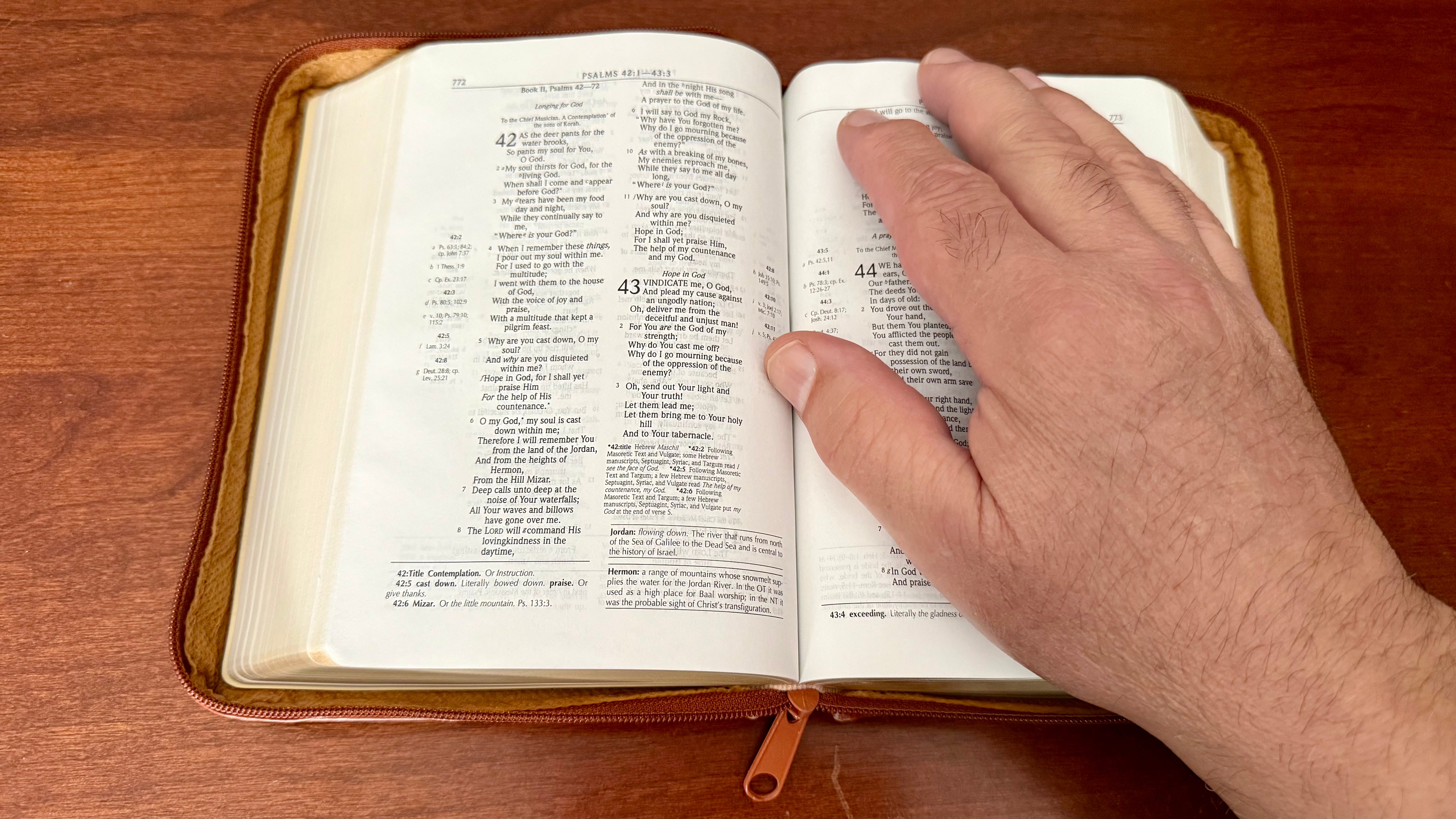
Photo © 2026, Steven Sande
“By day the LORD directs his love, at night his song is with me— a prayer to the God of my life.”
Psalms 42:8 NIV
At some point in the distant past, the Psalms were organized into five books. Psalm 42 is the first to be found in Book Two, and the psalms in this book are somewhat different than those in Book One (Psalms 1 - 41). How are they different? King David is the named author of 37 of the 41 psalms in Book One (the other four have no named author and it is assumed that David wrote those as well). In Book Two, other psalmists begin to appear: Solomon (David’s son), Asaph, the sons of Korah (musical Levites). David still claims authorship of 18 of the 31 psalms in Book Two (Psalms 42 - 72).
There’s an even more significant change in Book Two, and that is what is used as God’s Hebrew name. In Book One, He is commonly referred to by the name Jehovah (Yahweh, YHWH), while in Book Two His name is predominantly cited as Elohim. What’s the difference? Devotional website Word Embassy provided this short explanation:
Yahweh and Elohim both refer to the same true God, but they emphasize different aspects of His character. Elohim highlights God's power, majesty, and role as Creator. Yahweh highlights God's personal covenant name, His faithfulness, and His relationship with His people.
Psalm 42 is one of those written by the sons of Korah — think of them as the “worship team” of the temple in the days of David, although they most certainly didn’t rely on amplified instruments. They sang the Psalms, accompanied by musical instruments of the time — harps and lyres (more like a guitar than a harp, complete with a thick sound box and a cutout sound hole), cymbals, trumpets, flutes and tambourines. The sons of Korah are described as being exuberant in their music-making.
Just a thought here… I know there are many Christians who find modern worship music to be repetitive. One person we know jokingly refers to them as “7-11 songs”, meaning seven words repeated 11 times (they’re usually not that bad). If you’re one of these people, consider that the Psalms were the worship songs of their time, and Psalm 136 repeats one stanza — “His love endures forever” — 26 times! Psalms 118 is another song that uses repetition to a great extent. My point? Repetition in worship songs is nothing new.
Let’s look at today’s Psalm phrase by phrase. It begins with “By day the LORD directs his love.” As I mentioned earlier in today’s devotional, the covenant name of God — Jehovah, Yahweh, YHWH — is rarely used in Book Two of Psalms. This verse is one of the exceptions, using יְהֹוָה (yᵊhōvâ, Jehovah). This is the name of God who issued His commandments to His people, and here He is directing His love to His people.
In one of his commentaries listed on Enduring Word, Charles Spurgeon cited another commentator as saying:
i. “His expression is remarkable; he does not say simply that the Lord will bestow, but, ‘command his lovingkindness.’ As the gift bestowed is grace – free favour to the unworthy; so the manner of bestowing it is sovereign. It is given by decree; it is a royal donative. And if he commands the blessing, who shall hinder its reception?” (March, cited in Spurgeon)
Jehovah is commanding or directing His love to His people, and He does so “By day” and “at night.” God is good to His people both day and night, and there is something especially comforting about the words “at night his song is with me.” It’s as if God is calming the psalmist with a song in the dark, frightening hours of the night, a very pleasant and reassuring thought.
That song is “a prayer to the God of my life.” The psalmist is acknowledging the Lord as “the God of my life,” the source of life and provider of all sustenance. He’s reminding believers that we depend on God for all of our needs, both spiritual and physical.
The Bible Says has this to say about the last half of this beautiful Psalm:
The mention of song in the night is particularly meaningful. When darkness falls and troubles loom, the believer can cling to a melody of hope. Much like Paul and Silas singing hymns from a prison cell (Acts 16), the steadfast voice of faith can rise in the nighttime of the soul, proclaiming that God remains worthy of worship even in the bleakest hours.
As the psalmist calls the Lord as the God of my life, we see a personal, ongoing relationship with Him. The entire flow of struggle and overcoming described in these verses points to a longing fulfilled only in the presence of the Almighty. Through every wave, the covenant love of the One who made us invites us to trust Him more deeply and rest under His gentle care.
Day or night, God directs His love and blessing upon His people, a reassuring presence in our lives.
Heaven On Wheels Daily Prayer:
Heavenly Father, thank You for Your constant love during all of my days. At night, if I should be filled with fear and uncertainty, may Your song fill my heart as a calming reminder that You are always present as I seek You. AMEN.
Thank you please and may GOD bless you too through Jesus Christ. Am blessed to hear from you such interesting words of praise. In Jesus ' name, Amen. Great is the Lord for his covenants still stand in support of all believers and every one on this world